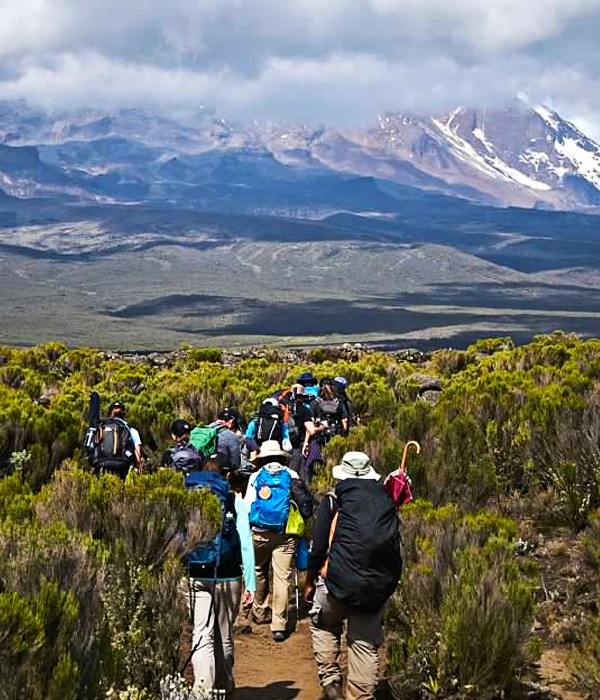
Kilimanjaro’s height of 5,895 meters (19,341 feet) above sea level is what makes it a popular destination for climbers seeking to conquer one of the world’s highest peaks. Among the Seven Summits, Kilimanjaro is one of the most prominent, and Mount Kilimanjaro Climbing is regarded as the best adventure activity. Many Kilimanjaro Climbing Packages are designed specifically to help trekkers acclimatize and enjoy the journey to the summit safely.
Mountains are categorized by height according to how far they stand above sea level. But they can also be measured differently from the Earth’s core. So, when it comes to the Seven Summits, where does Mount Kilimanjaro rank? In this post, we’ll do a deep dive into one of the most asked questions on Kilimanjaro – What is Mount Kilimanjaro Height? – and look at all the height features.
Mount Kilimanjaro stands at 5,895 meters (19,341 feet) above sea level. It is the highest mountain in Africa and also holds the title of the world’s tallest free-standing mountain.
In terms of global height ranking, Kilimanjaro is not among the top 10 tallest mountains in the world—those belong mostly to the Himalayas. However, its prominence, accessibility, and scenic diversity make it a top destination for trekkers and climbers worldwide.
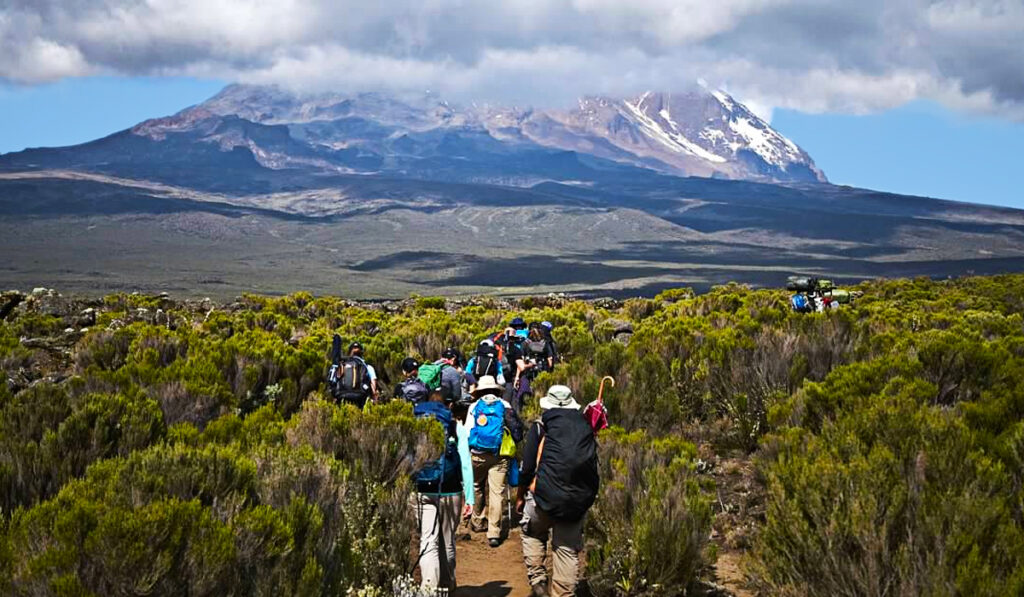
In terms of ranking amongst the highest mountains in the world, Mt Kilimanjaro is also the most prominent – with a prominence of 5,882 meters. Prominence is a measure of a mountain’s independent height relative to its surroundings.
But, the prominence of Kilimanjaro doesn’t place it among the highest peaks in the world when it comes to elevation. For example, Mount Everest, the highest mountain in the world has an elevation of 8,848 metres (29,029 feet).
This is more than twice the elevation of Kilimanjaro. Nevertheless, Kilimanjaro’s perfect location and prominence make it a popular destination for mountaineers from all over the globe. Below is a table reflecting the ranking of Mount Kilimanjaro in Africa:
| NAME OF THE MOUNTAIN | ELEVATION (in metres) | PROMINENCE (in metres) |
| Kilimanjaro, Tanzania | 5,895 | 5,882 |
| Mount Kenya, Kenya | 5,199 | 3,325 |
| Mount Meru, Tanzania | 4,566 | 3,050 |
| Mount Stanley, Uganda | 5,109 | 3,103 |
| Ras Dashen, Ethiopia | 4,533 | 3,220 |
| Mount Speke, Uganda | 4,890 | 1,220 |
| Mount Karisimbi, Rwanda | 4,507 | 2,477 |
As it’s evident from the above, Kilimanjaro is the highest mountain peak in Africa and the fourth most prominent in the world.
For mountain climbers, trekkers, and adventurers, Mount Kilimanjaro Climbing is an absolute favourite. Coming back to our question, Where Do You Think Mount Kilimanjaro Ranks in the Seven Summits? When properly analyzed, Mount Kilimanjaro is the fourth most prominent mountain in the world among the seven summits.
Measuring Kilimanjaro Height Above Sea Level is important for scientific backgrounds such as geology, meteorology, and ecology.
Hence, measuring Kilimanjaro Height in Feet is crucial to maintain the biodiversity of the region and supporting the different scientific disciplines.
Several methods are utilized to determine the height of Mt Kilimanjaro, each with its set of advantages and disadvantages. Some of the most commonly used methods are:
Ground-Based Surveys – This is one of the traditional methods used to measure the height of Kilimanjaro. Surveyors use instruments like theodolites and GPS receivers to measure the different Points of Elevation of Mount Kilimanjaro and calculate the height.
The method is labor-intensive and time-consuming but it offers accurate and precise measurements.
Airborne Laser Scanning – This method uses aircraft equipped with lasers to scan the surface of the mountain and create a digital terrain model. The model is then used to calculate the Mount Kilimanjaro Height.
This method is faster than ground-based surveys and can cover a larger area, but it is more expensive and requires specialized pieces of equipment.
Satellite-Based Remote Sensing – This method uses satellite imagery and radar to determine Mount Kilimanjaro Height. The satellites bounce radar waves off the mountain and measure the time it takes for the waves to return to the satellite.
Global Positioning System (GPS) – GPS technology can also be used to determine the height of mountains. Surveyors use GPS receivers to measure the elevation of points on the mountain and calculate its height.
Gravity Measurements – This method uses sophisticated instruments to measure the gravitational pull of the mountain. The mass of the mountain affects the strength of gravity in the surrounding area, and by measuring these variations, scientists can calculate the height of the mountain.
This method is highly accurate but requires specialized equipment and expertise.
In practice, a combination of these methods is often used to ensure accuracy and consistency. For example, ground-based surveys may be used to establish reference points, which are then used to calibrate satellite and airborne measurements.
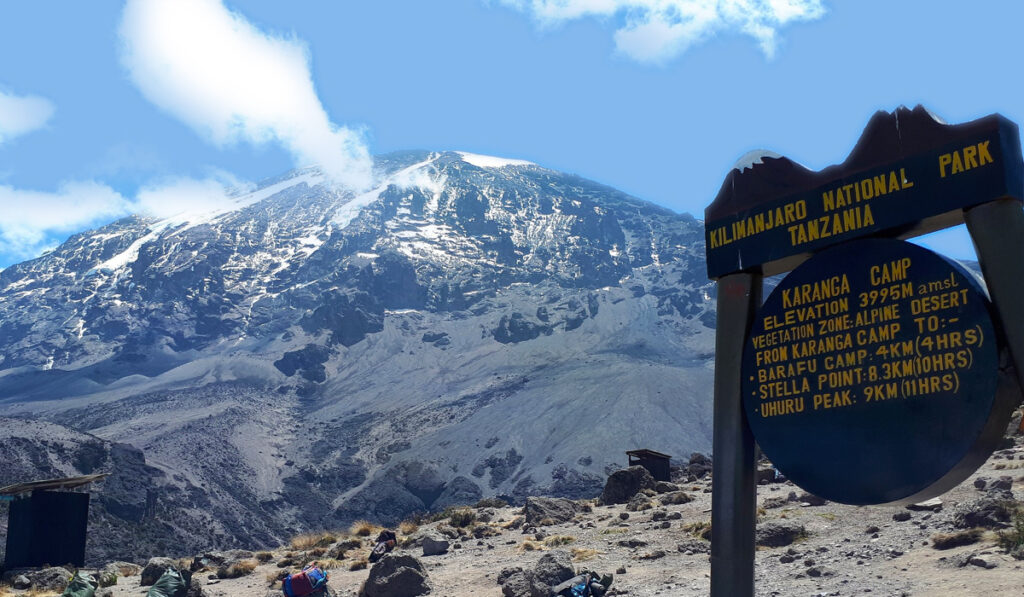
Kilimanjaro is not just the highest mountain in Africa but also one of the world’s most famous peaks. Located in Tanzania, it consists of three distinct volcanic cones, namely Kibo, Mawenzi, and Shira. Each of these peaks has a unique height, making Kilimanjaro a fascinating destination. You’ll get to traverse these peaks by opting for any of the Kilimanjaro Routes.
Kibo, the highest peak of Kilimanjaro, stands at an impressive height of 5,895 meters (19,341 feet). It is also the tallest free-standing mountain in the world. Kibo is a dormant volcano and is home to the iconic Uhuru Peak, which is the highest point on Kilimanjaro and the ultimate destination for trekkers. This is officially recognized as the Kilimanjaro Summit Height.
Mawenzi, on the other hand, is a rugged and jagged peak that stands at 5,149 meters (16,893 feet). It is the third-highest peak on Kilimanjaro and a popular destination for experienced climbers. The peak is characterized by cliffs and jagged ridges, providing a challenging climb for those brave enough to attempt it.
Shira, the oldest of the three peaks, stands at 3,962 meters (12,999 feet). It is the lowest peak of Kilimanjaro and is also a dormant volcano. Shira is characterized by a wide plateau and is a popular starting point for treks to the summit.
To get a better understanding of the heights of each of these peaks, below is a general overlay:
| PEAK | HEIGHT (in metres) | HEIGHT (in feet) |
| Kibo | 5,895 m | 19,341 ft. |
| Mawenzi | 5,149 m | 16,893 ft. |
| Shira | 3,962 m | 12,999 ft. |

You’ve gathered information concerning Mt Kilimanjaro Height, so now let’s put Kilimanjaro against some other iconic mountain peaks in the world and see how it measures:
Everyone who has questions about Mt Kilimanjaro Elevation naturally comes to the point of comparing it to Mount Everest.
Mount Everest sees almost 40,000 climbers each year, whereas, Mount Kilimanjaro attracts around 30,000 hiking enthusiasts each year around the globe.
If you take a close look at the success rates of both summits, there’s a glaring difference between the difficulty levels. Climbing Mount Kilimanjaro is a bit less challenging than ascending Mount Everest.
Mount Aconcagua is renowned worldwide for its spectacular sceneries and natural beauty. But when it comes to climbing both summits, it’s clear that you should go for Mount Kilimanjaro as it takes two weeks more than it takes to ascend to Uhuru Peak of Kilimanjaro.
Attempting to reach the summit of Mount Denali is significantly more challenging than opting for a Kilimanjaro Climb.
The reason for this is that the steps are very high on Denali and the oxygen levels are comparatively lower than that of Mt Kilimanjaro. Plus, your body will get acclimated to the Kilimanjaro Weather more easily.
Similar to Kilimanjaro, Mount Elbrus also doesn’t require any technical expertise but because of the poor visibility, the trails can be more difficult.
Compared to Mount Carstensz, Mount Kilimanjaro has a more accessible trekking trail. Plus, proper rock climbing skills are also necessary for scaling Mount Carstensz and the location isn’t that convenient too.
For a refresher, below is a comparison of The Height of Kilimanjaro to some other notable mountains around the globe:
| NAME OF THE MOUNTAIN(S) | ELEVATION (in metres) | PROMINENCE (in metres) |
| Mount Everest, Nepal | 8,848 | 8,848 |
| Mount Aconcagua, Argentina | 6,962 | 6,962 |
| Mount McKinley (Denali), North America | 6,190 | 6,144 |
| Kilimanjaro, Tanzania | 5,895 | 5,882 |
| Mount Elbrus, Russia | 5,642 | 4,741 |
| Mount Vinson, Antarctica | 4,892 | 4,892 |
| Mount Carstensz (Puncak Jaya), Papua | 4,884 | 4,884 |
| Mount Kosciuszko, Australia | 2,228 | 2,228 |
Here are some facts about Kilimanjaro’s Height that you probably didn’t know about: –
We’d love to hear from you! Speak to one of our
travel experts.

Climate change has been affecting Mount Kilimanjaro in several ways. One of the most major impacts it has left is the melting of the mountain’s glaciers.
| YEAR | HEIGHT (in metres) |
| 1889 | 5,895 |
| 1938 | 5,899 |
| 1959 | 5,892 |
| 1978 | 5,880 |
| 1999 | 5,895 |
| 2019 | 5,892 |
The melting of the glaciers has several implications for the mountain’s height. First, the loss of ice reduces the mass of the mountain, which can cause the summit to sink.
Second, the melting of the glaciers can lead to the formation of new crevasses and ice cliffs, which can make it more difficult to climb the mountain.
And, finally, the loss of the glaciers can have significant ecological and economic impacts, as the mountain’s glaciers are an important source of water for local communities and support a unique ecosystem of plants and animals.
In addition to the melting of glaciers, Climate change is also affecting Kilimanjaro’s height by altering precipitation patterns on the mountain.
| YEAR | MEAN TEMPERATURE (in Degrees) | PRECIPITATION |
| 1957 | 6.8 °C | 2000 mm |
| 1977 | 6.8 °C | 2000 mm |
| 1997 | 7.3 °C | 1900 mm |
| 2017 | 8.1 °C | 1500 mm |
On the whole, the impacts of climate change on Kilimanjaro’s height are complex and multi-layered. While the exact magnitude of these impacts is still uncertain, it is clear that the melting of the mountain’s glaciers is having significant ecological, economic, and social consequences for local communities and mountaineers.
Imagine standing on the top of the world and gazing down below you. It’s an amazing feeling, right? Well, that’s exactly how it feels standing on the summit of Mount Kilimanjaro. A Kilimanjaro Climb means it will give you a chance to experience Africa’s wildlife and climb one of the world’s Seven Summits. So, what’re you waiting for?
Book Kilimanjaro Climb with African Scenic Safaris and experience Mount Kilimanjaro Climbing in all its glory. We have extensive experience planning Private Kilimanjaro Treks, ranging from solo treks to charity groups of over 30 climbers, and can also accommodate organizations choosing to operate multiple group departures. Contact our trekking experts at info@africanscenicsafaris.com to begin planning your trip of a lifetime.