What Makes the Serengeti So Legendary?
The word iconic comes to mind when thinking of Serengeti National Park. Have you dreamt of safaris on the vast African continent? Then, there’s a strong chance you’ve dreamt of the golden Serengeti savannahs. Meaning a place where the land runs on forever, the Serengeti is among the top wildlife destinations and probably one of the most remarkable natural wonders left on our planet.
Only a few places on Earth have such rich habitats, unspoiled lands, and thrilling wildlife experiences. Home to the greatest show on the planet, some of the largest concentrations of animals and birds, and a range of safari activities, the endless plains of the Serengeti are truly a wonder.
For those seeking something extraordinary, Serengeti Safari Packages bring you face-to-face with Africa’s raw beauty. And if you’re looking to explore more of the country’s wonders, Tanzania Safari Packages lets you combine this unforgettable experience with other diverse regions across the country.
Quick Facts on Serengeti National Park
- Area : 14,763 sq. km. (5,700 sq. miles)
- Established in : 1951
- Designated as a UNESCO World Heritage Site in : 1981
- Coordinates : 2.3333° S, 34.8333° E
- Opening Hours : 6 am to 6 pm (open every day)
- Entrance Fees : For Adults: $70. For Children (between the ages of 5 to 15): $20.
Location And Geography
Situated in the northern region of Tanzania, the golden plains of Serengeti National Park stretch for almost 15,000 square kilometres. The park is located completely in the northeastern part of the Simiyu region and the eastern Mara region.
The landscapes of the Serengeti Ecosystem are extremely varied. They range from savannahs and open grasslands to hilly woodlands and riverine forests. This diversity is because of the extreme weather conditions, in particular the combination of heat and wind.
The habitats of the Serengeti are believed to have originated from a series of volcanoes. The volcanic activity helped shape the features of the ecosystem by adding craters and mountains to the surroundings.
The Mara River flows through the Kenyan highlands to Lake Victoria, where terrific migration crossings happen. This is the only river in the ecosystem that flows permanently, and it plays a key role in many Serengeti Safari Tours.
Flourishing Flora of Serengeti National Park
The Serengeti's diverse ecosystem is home to hundreds of native and non-native plant species spread across its vast landscape.
- Over 300 species of plants are recorded in Serengeti.
- 15 alien species of plant are distributed throughout the park as well.
Acacia trees and sausage trees are the two plants that Serengeti is famous for. When you’re out on game drives in the vast savannahs, you’ll be able to see them right from your safari vehicle.
- Woodlands are commonly found in the northern region of Serengeti, as this section is covered by hills.
- Lush savannahs with some acacia trees, make up the surroundings of the Western Corridor. The Grumeti River also makes its way through these surroundings.
The flora of the park isn’t just great to look at though, it offers the wildlife of the park life force. And, without flora, your Safari In Serengeti here will seem wholly different. Forget scenic views, the lush green cover of the park will just be dry lands.
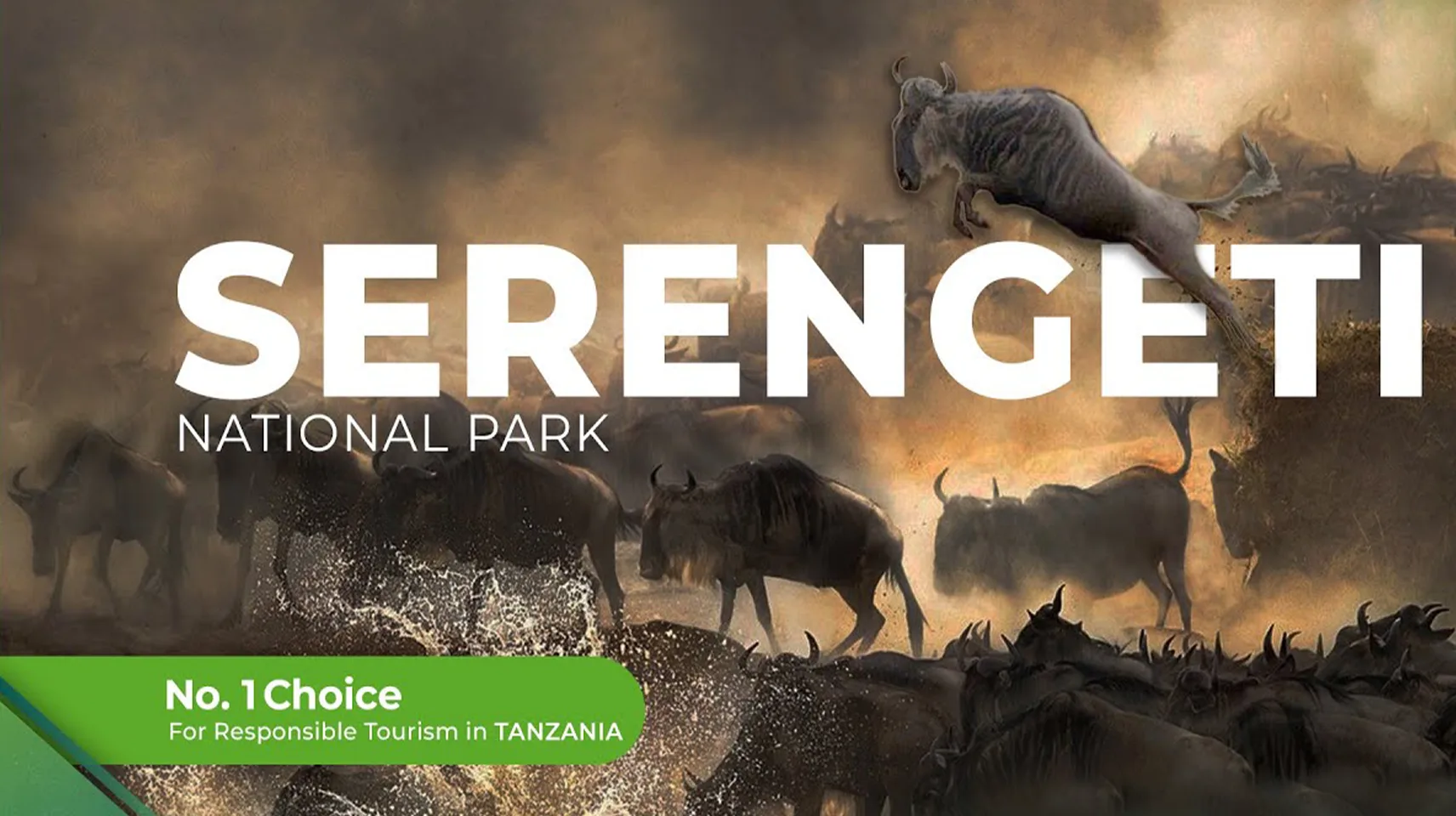
Over two million animals move through Serengeti’s golden plains—wildebeests, gazelles, zebras, lions, cheetahs, and hyenas—creating nature’s most breathtaking theatre during the Great Migration in Tanzania.
Serengeti Safari Areas
The entire ecosystem of Serengeti National Park is a region of amazing biodiversity. If you want to have a safari in the park, you must know what the different areas have in store. So, the following are the primary five safari areas in Serengeti National Park:
The Seronera Region
The southeastern area of Seronera is the centre of wildlife viewing in the wet season, from December to April. Huge herds of wildebeests gather here during this time. This makes for amazing predator action, and Seronera is widely known as the predator capital of Tanzania.
- Lion sightings along the Seronera River are almost guaranteed.
- The riverbanks are home to some of the densest populations of leopards. They can be seen on top of the sausage trees.
- Some patience combined with a bit of luck may also result in sightings of tree-climbing lions.
- The region is also home to black rhinos and many herbivores.
- The plains around the Kamuyo Hills are a great site to witness cheetahs, elephants, and spotted hyenas.
Ndutu Plains
If you want to experience the essence of classic Tanzania Safari Packages, then heading to the Ndutu Plains will be perfect. These vast open grasslands are home to several animals. Giant herds of wildebeests and zebras can be seen during the wet season.
- The Ndutu Plains is also a site of the calving season, where wildebeests give birth between January and March.
- The woodlands around Lake Ndutu offer shelter to an extensive range of birds, with Fischer’s lovebird being one of the most fascinating sights.
- The southeastern plains are surrounded by many clusters of kopjes.
- These kopjes provide habitat for wildlife like klipspringers, rock hyrax, leopards, raptors, and more.
- Lions also use the kopjes as a vantage point to survey the plains. The Simba Kopjes is a great place to see these majestic kings of the golden savannahs.
Grumeti Game Reserve
In the western reaches of the Serengeti lies an undiscovered gem – the Grumeti Game Reserve. This reserve is located in a beautiful and remote corner of the park. And because of this remoteness, the game-viewing experience is heightened.
- The number of people who can stay in the camps surrounding the region is limited.
- As a result, the number of crowds is fewer—great news if you want a private safari experience.
- Only a few areas in the Serengeti offer walking safaris, which makes walking safaris in the Grumeti Game Reserve a special treat.
- You’ll be able to enjoy hours on foot with your safari guide and learn about the birds and smaller animals in the area.
- Wildlife viewing in the reserve is great throughout the year.
- The savannahs in the southern region of the Grumeti River support a range of wildlife—wildebeests, giraffes, zebras, and lions.
- The remote surroundings north of the river are a great place to see cheetahs.
Lobo Hills and the Northern Plains
The northern plains of the Serengeti are undiscovered, beautifully scenic, and remote compared to the plains of the Southern Serengeti. The region stretches from the Lobo Hills to the Seronera and is characterized by rolling green hills.
- This landscape is a pleasant departure from the flatter plains of the southern region.
- Because the northern plains are much denser in terms of vegetation, animals are harder to spot.
- But the northern plains have fewer crowds, so it should certainly be considered despite the drawbacks.
- You may even get to experience a game drive without another vehicle in sight.
- Just picture cruising across a landscape of open grasslands with some dense woodlands sprinkled in—a serene experience for sure.
The Western Corridor
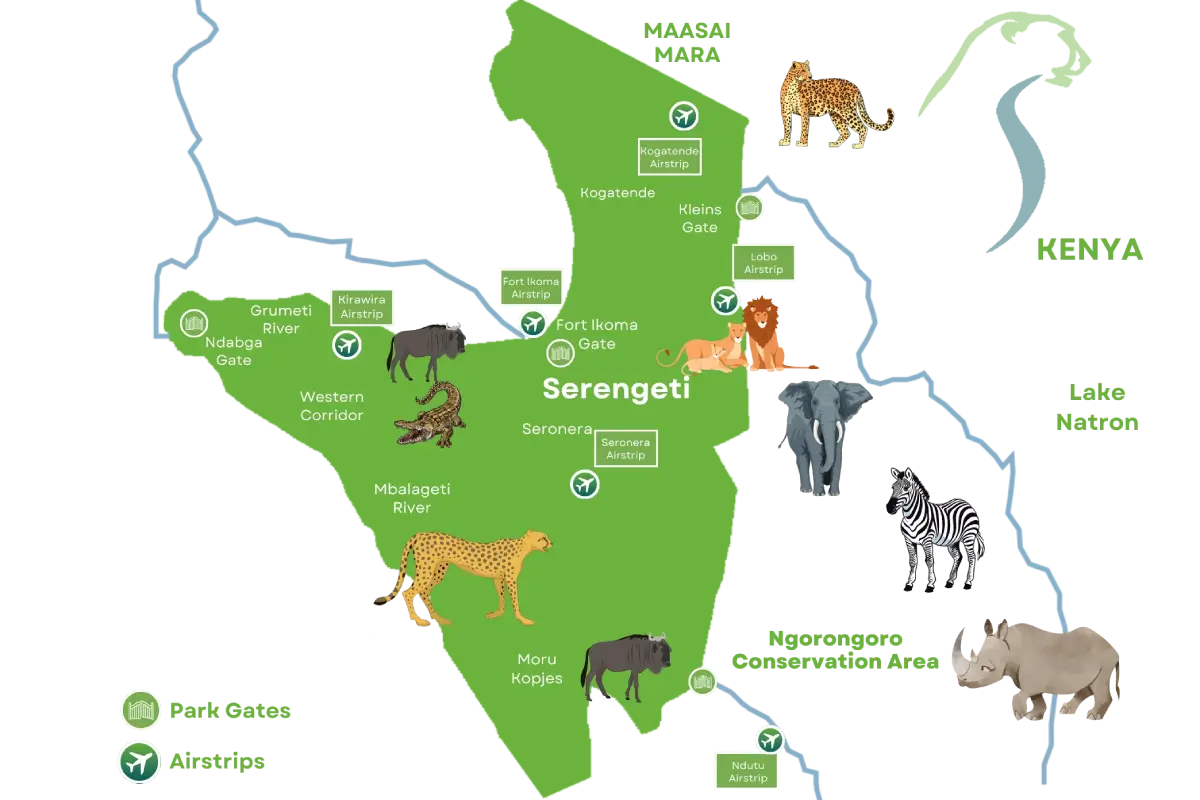
The Serengeti Western Corridor is an expanse of land following the course of the Grumeti River from Central Serengeti out towards Lake Victoria. The foremost feature of the Western Corridor is a pair of rivers – the Grumeti River and the Mbalageti River.
- The habitat of this region is mostly a combination of woodlands, dotted with dense whistling thorns and open savannahs.
- These habitats are home to a substantial range of wildlife like elephants, wildebeests, lions, zebras, and several species of antelopes.
- The Western Corridor is a wonderful portion of the Serengeti that supports a spectrum of resident wildlife all year round.
- From May to July, the migrating herds pass through this region, making it a highlight of Serengeti Migration Safaris.
Serengeti Wildlife
Serengeti is a place where the endless plains meet the horizon—and where travellers witness boundless wildlife. The main reason people visit this national park is to see animals in a raw, unspoiled natural environment. And rest assured—you will experience just that.
The golden savannahs of the Serengeti are among the world’s greatest wilderness regions. The transition from rich flat soils to hilly terrain results in a wide range of vegetation and diverse habitats.
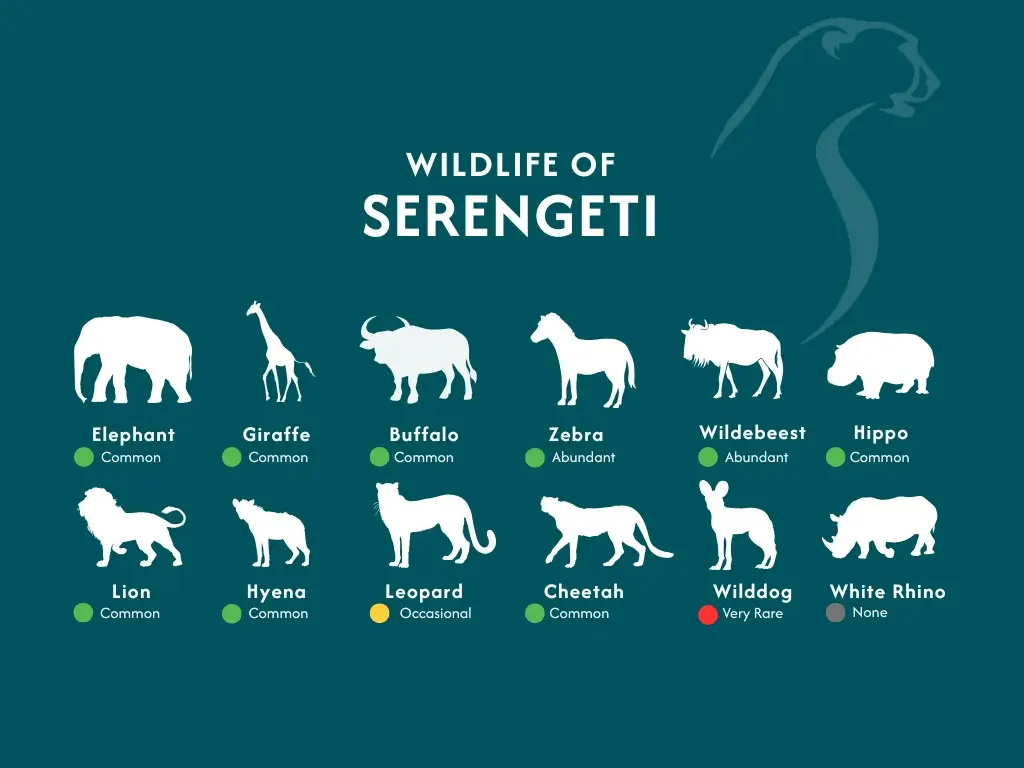
A distinctive habitat is the riverine forest, favoured by crocodiles and hippos. Other commonly sighted animals include long-necked giraffes and several hoofed species such as zebras, topis, impalas, elands, and Grant’s gazelles.
All the big cats can be spotted in the park:
- Lions are seen almost everywhere.
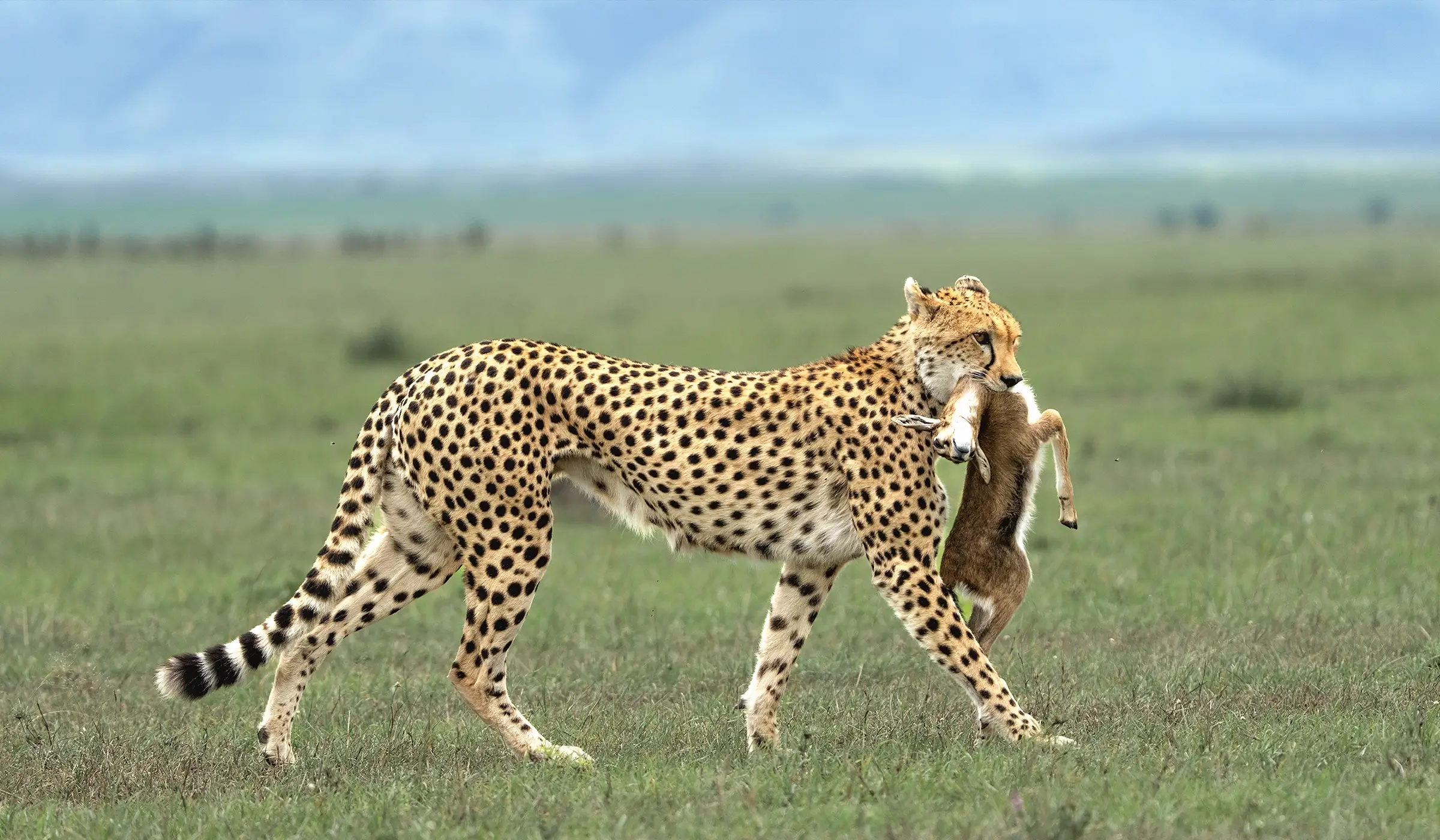
- Cheetahs thrive in the southeastern grasslands.
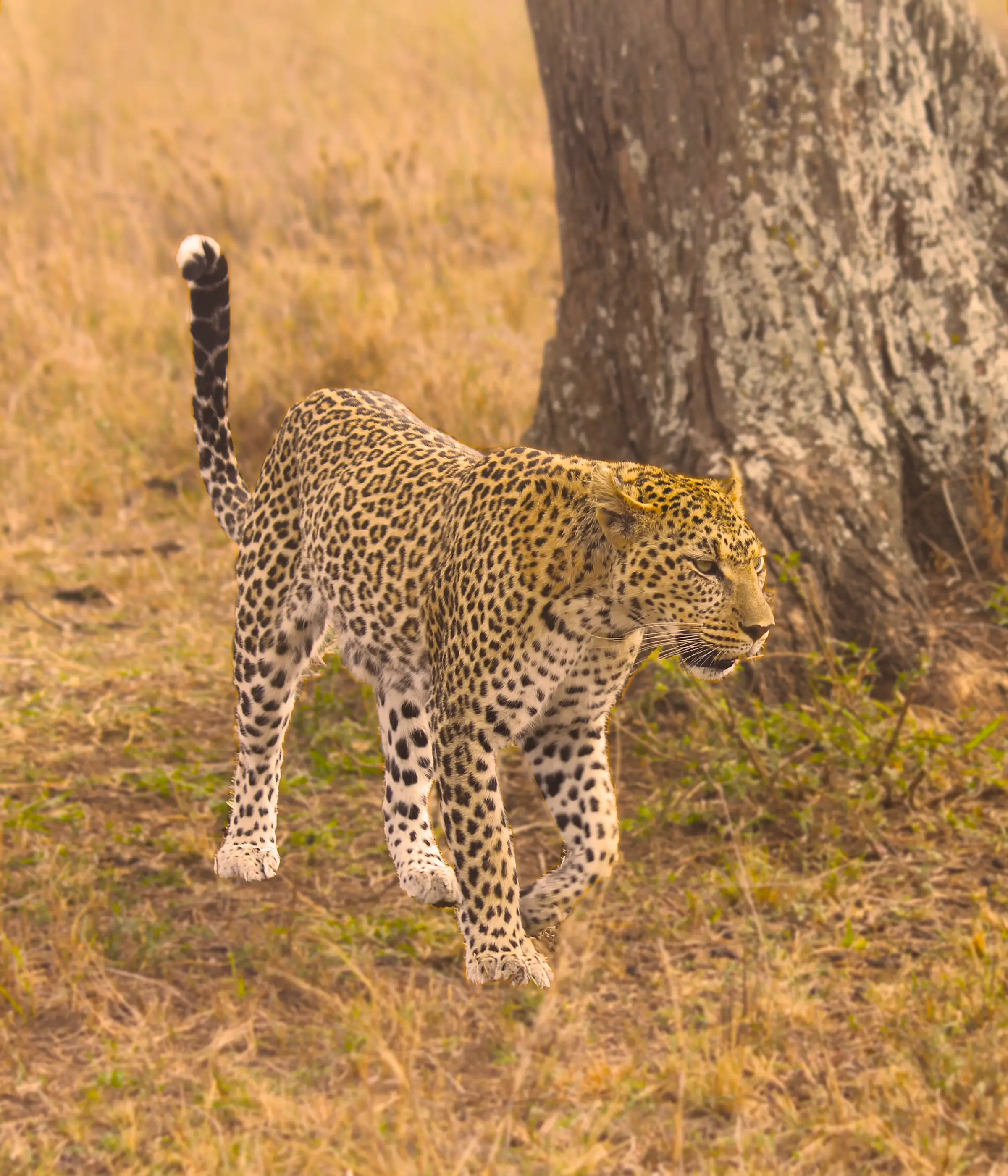
- Leopards often rest in the sausage trees lining the Seronera River.
The Big Five
The Big Five define the essence of Tanzania Safaris—lions, leopards, elephants, Cape buffaloes, and rhinoceros.
Why are they called the “Big Five”? The term was coined by colonial hunters—not for size, but for the difficulty of hunting them on foot.
Seeing them in their natural habitat is unforgettable. It’s the kind of experience that lingers in your memory forever.
Check out our Tanzania Big Five Safari Package for more details on experiencing these iconic animals up close in their natural habitats.
1-Lions
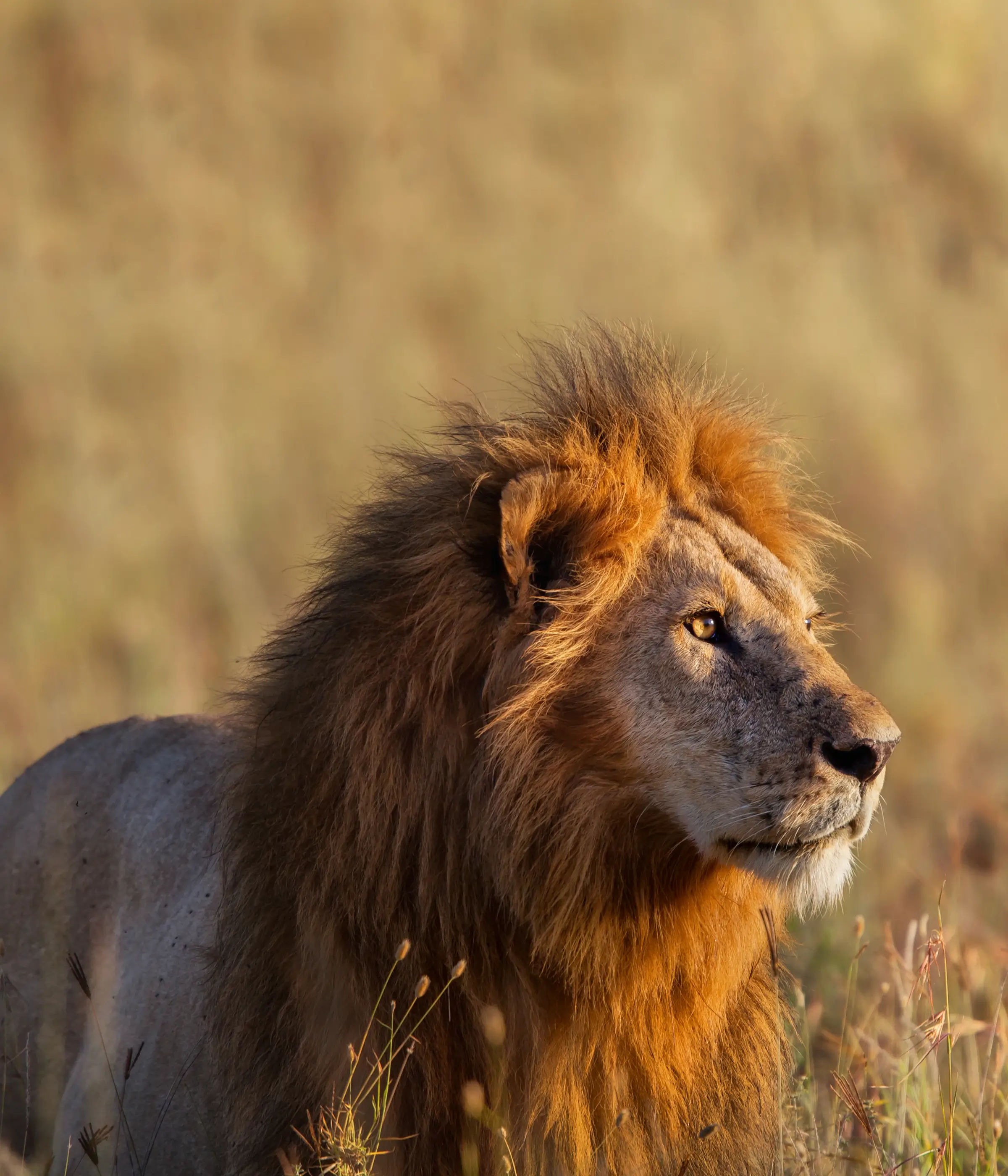
With around 3,500 lions in over 300 prides, the Serengeti has the largest lion population in Africa. Lions live in social prides where females do most of the hunting. Watch them snoozing under trees—or climbing them—in the Seronera region.
2-Elephants
Over 7,000 elephants roam the Serengeti. These gentle giants wander through open plains and dense woodland. You may even see them near your Serengeti accommodation, quenching their thirst at a nearby waterhole.
3-Leopards
Leopards are graceful and elusive. Their camouflage is excellent, making them hard to spot. But look up in the sausage trees of Seronera—you might just catch a glimpse of one lounging in the branches.
5-Cape Buffaloes
Buffaloes are usually seen near waterholes. Their intense stare and strong build make them awe-inspiring. With numerous herds in Serengeti National Park, sightings are common.
4-Rhinos
Rhinos are rarer here than in some other parks, but sightings are possible. Thanks to ongoing conservation efforts, their numbers are slowly increasing. Since females only give birth every five years, they remain one of the most elusive animals in the African Serengeti. With our expert guides, you might get lucky and spot one on your Serengeti Safari.
Birdwatching Experience in Serengeti
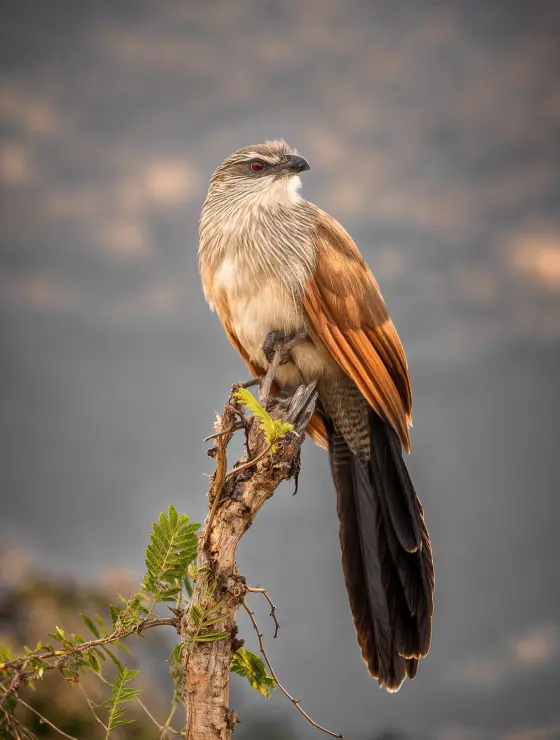
Even if you’re not into birds now, a Serengeti birdwatching experience might change that. With over 500 bird species, the park is a true haven for birders.
Highlights include:
- Secretary bird
- Kori bustard
- Green and yellow Fischer’s lovebird
The Serengeti-Mara ecosystem is home to five endemic species found nowhere else on Earth.
- For the best birdwatching experience, visit between November and April, during nesting season.
- Migratory birds from Europe and North Africa are also present during this time.
Want a more extensive birding trip? Combine your Serengeti Trip with a visit to Lake Manyara.
A Bit of Small Talk
Insects may not be your favourite part of the safari, but they’re essential to the Serengeti ecosystem. Our guides are happy to explain their importance on Safari in Serengeti.
Key insect groups include:
- Grasshoppers
- Termites
- Butterflies and moths
- Dung beetles
- Ants
Getting to Serengeti National Park
Even though Serengeti is situated in a rather remote corner, accessing the park is fairly easy. Your most suitable option would be to fly into the town of Arusha. There are seven airstrips in the park, so it’ll be very convenient.
Or you could go another way, which is to book a 4WD Tanzania safari vehicle from Arusha to Serengeti. This way you’ll get an opportunity to visit a couple of other parks along the way. Naturally, you can also choose to combine both these options and book a one-way safari and fly back to Arusha.
Getting to Serengeti by Air
Getting To Serengeti National Park by air is the most convenient and quick option. You will have a couple of choices if you want to access Serengeti by air.
International Air Travel
Our recommended point of entry is Kilimanjaro International Airport. It’s situated between the towns of Arusha and Moshi and is around 320 km. from Serengeti’s southern entrance.
There are some international flight options you can choose from. We recommend carriers such as KLM Royal Dutch Airlines, Kenya Airways, Turkish Airlines, and Ethiopian Airlines.
Airlines like Emirates and British Airways also fly into Dar es Salaam (DAR). Though, you may have to stay overnight at a hotel and then hop on a domestic flight.
Regional Travel
All regional flights are operated by local airlines like Coastal Aviation and Grumeti Air. Flying from Arusha Airport (ARK) and Kilimanjaro International Airport (JRO) is the most favoured route.
Private Airstrips
Another quick and convenient option to get to Serengeti is booking a private or charter flight. Some of the Tanzania luxury lodges have their private airstrip and they can arrange a direct scheduled or private charter flight from Arusha Airport or Kilimanjaro International Airport (JRO).
Getting to Serengeti by Road
If you’d like to skip taking a flight and take the road less travelled, then this option is for you.
Self-Drive Safaris
Self-drive safaris are possible but not recommended. This is because it takes utmost care and careful planning to drive by yourself through the park. A 4WD safari vehicle is necessary to access the roads throughout the year. You can get fuel at the Seronera region in Southern Serengeti.
Drive-in Safaris
You can get to Serengeti National Park by booking drive-in safaris. They usually start in the town of Arusha. From there, it will take about 7.5 hours to drive to the Serengeti.
Access Points of Serengeti National Park
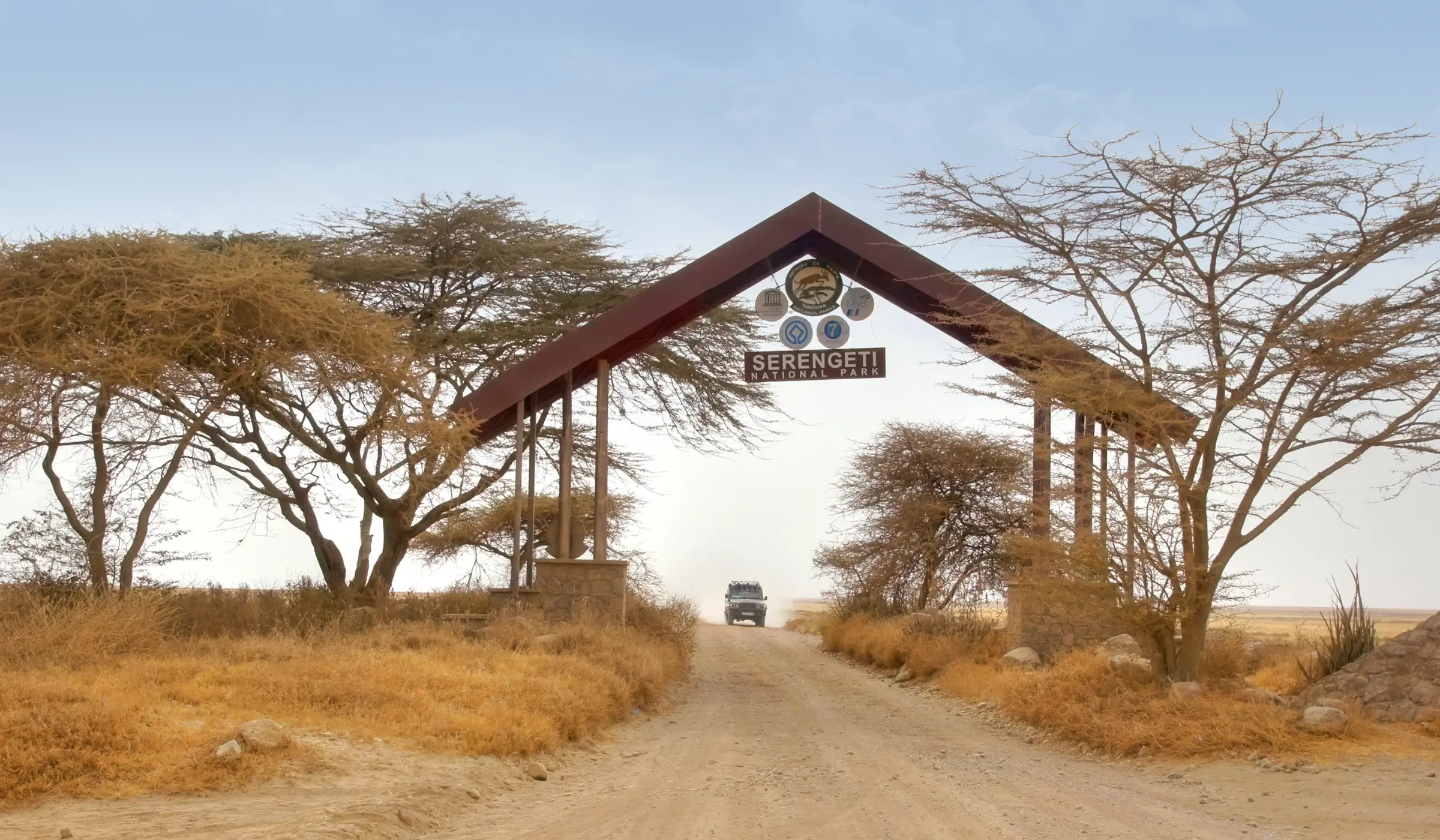
There are four primary entry and access points in the Serengeti. They are referred to as gates.
Ndabaka Gate
This gate is the main access point for the Western Corridor region. Ndabaka Gate is located around 145 km. from the Seronera region and it takes about 1.5 hours to drive from Mwanza to the gate. Opening hours are from 6.00 am to 6.00 pm. However, keep in mind that the last time of entry is 4.00 pm.
Fort Ikoma Gate
The gate is situated on the northwestern border of the Serengeti. Fort Ikoma Gate is easily accessible from the Seronera region with the drive taking about an hour. It's a common entry point for Serengeti Safari Tours.
Naabi Hill Gate
This is the main access point of Serengeti National Park. The gate is situated around 45 km. from the Seronera region. Opening hours are from 6.00 am to 6.00 pm.
Handajega Gate
Located in the southwestern region of Serengeti, this access point is rarely used. The gate is just six km. from the Grumeti Game Reserve and is close to the Kirawira B airstrip.
Bologonya Gate
This access point of Serengeti National Park is located just south of the Kenya-Tanzanian border. It lies in a remote area of the park; thus, the gate is rarely utilized.
Klein’s Gate
This access point is located in the northeastern region of the Serengeti. The opening hours are the same as the above two. I.e. From 6.00 am to 6.00 pm.
History Of Serengeti National Park
It’s hard to believe now, but there was once a time when the Great Wildebeest Migration was completely unknown to the world.
Going back to the early 1900s, explorers described the unbelievable plains of the Serengeti and the enormous numbers of animals found there. This seemed too amazing to be true. And it went on like that for a few years.
- But, in the 1920s, the first photographs of the region came out. And, everyone was left stunned at the sight of this spectacle.
- In 1930, an area of over 2,000 square kilometres was set up as a game reserve. This land is now known as the Southern and Eastern Serengeti.
- In 1951, the national park was established. The headquarters of the park was based on the rim of the Ngorongoro Crater. The original park also included an area that is now called the Ngorongoro Conservation Area.
- Though, the area was separated from the park in 1959. This was done so that the native Maasai communities could live and graze their cattle without any interference.
- In 1961, the Masai Mara National Reserve was set up in Kenya. In 1965, a permanent corridor was created between the Mara River and the Kenya border. It was called the Lamai Wedge.
- This allowed the herds to migrate from the Serengeti savannahs to the Loita plains in the north. Later on, the Maswa Game Reserve was established in 1962.
What was once an undiscovered treasure, is now renowned across our planet! The Serengeti was among the first places to be declared a UNESCO World Heritage Site in 1981. Now you can have the pleasure of exploring the endless plains of the park on Safaris To Tanzania.
Weather And Climate of The Serengeti
The extensive ecosystem of Serengeti National Park has many seasonal differences when it comes to weather and climate. The park experiences a cool and dry season from May to August, a warm dry season in September and October, and a wetter hot season from November to April.
Temperatures
Everyone has a belief that Africa is mostly a very hot place, but the temperatures of the Serengeti are moderate and pleasant. It rarely gets uncomfortably hot and temperatures drop during the nighttime and early mornings.
The minimum and maximum temperatures vary with the seasons. The wet season is generally the warmest. Understanding this variation helps in deciding the best time to visit Serengeti National Park. The following chart will show the average temperatures of Serengeti in more detail.
Average Monthly Temperatures – Serengeti National Park
| Months |
Temperature(°C) |
| January |
26 |
| February |
26 |
| March |
16 |
| April |
15 |
| May |
15 |
| June |
15 |
| July |
27 |
| August |
15 |
| September |
15 |
| October |
15 |
| November |
16 |
| December |
16 |
Good To Know : The average maximum temperatures vary based on elevation: from 15 Celsius around the crater highlands to around 30 Celsius near Lake Victoria.
Rainfall Period
Two rainfall periods govern the climate of Serengeti National Park. The first to break the grip of the dry season is the short rains, in November and December. Long rains follow soon in the period from March to May.
Though it rarely rains for a whole day, it does rain on most days. These rains turn the landscapes of the plains into vibrant green. This is why the season is referred to as the green season.
Some Insights : Sometimes the rains fuse into a single extended period. This mainly happens in the northern region of the park. Also, the short rains may not occur entirely, particularly in the southeast region of the Serengeti.
Best Time to Visit Serengeti
The density of Animals in the Serengeti National Park is among some of the largest on the planet. This is why safari experiences in the park are spectacular throughout the year.
However, the optimal time to visit is in the dry season, in January and February, and from June to October. The reason behind this is the vegetation. The grass is at its most thin in the dry season which makes spotting animals easier.
Although, this in no way means that visiting outside of the dry season is inferior. No at all, the wet season (from November to May) is considered the best time for birdwatching in the Serengeti. Moreover, in the wet season, there are fewer crowds around. So, if you want to have an exclusive Tanzania Safari Experience, this is the season for you.
Following the Great Migration
You just have to know what time you should visit Serengeti to admire one of the last remaining natural wonders of the world – The Great Migration.
Winter is the best time to see these supersized groups in Southern Serengeti. Whereas, June and July are the Best Time to Visit Serengeti to see the migration in the Western Corridor. August and September are perfect months to witness the herds in the northern section of the park.
Below, we’ll look at the monthly breakdown of Visiting Serengeti National Park. This will help you decide when to visit based on what experiences you’d like to have.
The southern plains of Serengeti National Park are beautiful in January. Because it rained briefly in December, the land looks clean and green. Wildebeest are giving birth, which makes animals like lions and hyenas want to eat them.
Wildlife viewing is amazing, and there are lots of chances to take pictures. In particular, the Ndutu area is busy because that's where the herds are gathering to give birth.
This month has great weather and not as many people, making it perfect for tourists who want to have a real safari experience in Tanzania's most famous park.
- Southern Serengeti grasslands fill with thousands of pregnant wildebeest mothers.
- The Ndutu plains become a wildlife nursery during this short dry season.
- Scenic landscapes with fertile volcanic soils create a vibrant safari experience.
- High season means excellent sightings and well-maintained safari routes.
- Clear weather and minimal rain make for smooth game drives.
Our Overview
A good time to visit
If you want to see a lot of wildlife, February is often called the best month to visit the Serengeti. It's the busiest time for giving birth, and thousands of wildebeest are giving birth on the southern plains.
There are a lot of young cats that are easy prey for big cats, so they often eat each other. There are a lot of exciting times on game drives in and around Ndutu and the southern Serengeti.
This month is a dream for nature shooters and safari fans alike, with its lush green scenery, busy herds, and dramatic skies. You can expect to see amazing wildlife and fewer cars than during peak season.
- Half a million wildebeest calves are born on lush green plains.
- Big cats arrive, drawn by vulnerable young wildebeest herds.
- Witness intense predator-prey interactions across the southern Serengeti.
- Short dry season continues, with warm days and minimal rain.
- Prime month to see the circle of life in action.
Our Overview
A good time to visit
Weather in February
Cloud
Tanzania's national parks, like the Serengeti, go through a change in March. The long rains start at the end of the month, but there is still a lot of wildlife in early March.
From Ndutu, migratory herds start to move northwest, but the middle Serengeti is still good for farming. You can always see animals, and the light rain makes the skies look beautiful and keeps the crowds down.
With lower hotel prices, this is a great month for visitors who want to save money and find some alone time. Get ready for quiet lodges, peaceful times in the bush, and a chance to see the Great Migration in action.
- Afternoon rains begin across the southern plains and woodland areas.
- Herds move slowly northward across rich, green open savannahs.
- Fewer tourists mean peaceful safari drives with dramatic skies.
- Expect warm daytime temperatures despite frequent cloudbursts and thunder.
- Photographers enjoy dramatic contrasts and stormy landscapes in March.
Our Overview
A good time to visit
The Serengeti gets a lot of rain in April, but it's still beautiful. When it rains, the park, especially in the middle and western parts, turns into a lush green paradise.
Even though it might be harder to get to some places, now is a great time to discover the more remote corners. There will be fewer people, which means better deals and a more personal safari.
April is a great month to look into Serengeti Safari Packages if you want to save money. There are still a lot of birds and animals that live in the park, and there is plenty of room to breathe.
- Long rains bring lush scenery and scattered wildlife across the plains.
- Wildebeest begin migrating north through Moru Kopjes and Seronera.
- The Seronera region offers great resident wildlife sightings during wet spells.
- The low season brings fewer crowds and discounted safari accommodations.
- Birdwatchers enjoy spotting colourful migrants and nesting species this month.
Our Overview
A good time to visit
May is still in the middle of the long-wet season, but safari fans should enjoy this month. There are rolling fields with wildebeest and zebra in the Serengeti. It is quiet and green.
Herds of migratory animals start to make their way towards the western passage, and people are still often seeing predators. The cooler weather makes game drives more pleasant, and the scenery is beautiful for taking pictures. Fewer cars mean more time to spend with wildlife.
For people looking for Serengeti Tour Packages during the off-season, May is a great month to go because it is quiet, cheap, and there are lots of animals to see.
- Wildebeest reach the Western Corridor as the rutting and mating season starts.
- Herds gather in long columns moving toward the Grumeti River crossings.
- Afternoon storms continue, but mornings are often clear and dry.
- Riverbanks become key spots for observing wildebeest activity.
- May offers spectacular behaviour without peak-season visitor numbers.
Our Overview
A good time to visit
June marks the start of the dry season, making it one of the Best Times to visit Tanzania for a classic safari. The grasses begin to thin, revealing more wildlife, and the Great Migration moves into central and western Serengeti.
This is an excellent month for seeing massive herds, predator hunts, and diverse habitats. The weather is cool and dry, ideal for game drives and photography.
Safari-goers can expect vibrant wildlife activity and fewer crowds than peak months. Bookings start to increase, so plan in advance for the best camps.
- Dry season starts, ideal for photography and wildlife movement visibility.
- Wildebeest herds prepare for the Grumeti River's challenging crossing.
- Lower tourist numbers offer quiet yet thrilling game drive experiences.
- Crocodile encounters intensify near riverbanks during wildebeest crossing attempts.
- Excellent time for classic game viewing in the western Serengeti.
Our Overview
A good time to visit
A Serengeti safari Tour in July is very exciting, especially in the western and northern areas where the Great Migration picks up speed. A lot of wildebeest and zebras gather near rivers to get ready for exciting crosses.
Because it is dry, it is easier to see wildlife, and there are a lot more reports of predators. Along the Grumeti River, things will be busy, and the savannahs will be full of activity.
This is the busiest time of the year for safaris in Tanzania, so places to stay start to fill up quickly. The mood is electric, the scenery is golden, and the animal experiences are unforgettable.
- Mara River crossings begin with dangerous jumps and chaotic stampedes.
- Massive herds stretch across northern Serengeti into Masai Mara.
- Crowds increase as safari-goers gather near famous crossing points.
- Booking early is essential for the best riverfront safari lodges.
- Wildlife drama peaks during predator-heavy scenes at the river.
Our Overview
A good time to visit
August is peak safari season and one of the busiest months in the Serengeti. The Mara River crossings in the northern region are at their most dramatic—herds plunging into crocodile-infested waters, predators in pursuit. It’s intense, wild, and deeply moving to witness.
If you're looking for premium Serengeti Tour Packages, this month delivers unrivalled wildlife action and dry, clear weather. However, it's also the most crowded, so booking well in advance is essential.
For those chasing the migration, August offers the iconic African safari experience in full swing.
- Ongoing river crossings in the far north Serengeti thrill seasoned safari-goers.
- Excellent wildlife density near rivers due to dry landscapes.
- Watch elephants, lions, and leopards gather near water sources.
- Northern plains offer beautiful golden hues under dry skies.
- Prime time for action-packed scenes and vibrant wildlife photography.
Our Overview
A good time to visit
The herds are still in the northern Serengeti and the Masai Mara region in September, so there is still a lot going on. The watching of wildlife is still very good, with crossings happening and big cats still hunting.
It's quieter and feels more private in the southern plains. The sky is clear and the temperatures are just right.
If you're looking for Things to do in Serengeti, this month offers both exciting experiences and the freedom to explore. People who have been on safari before or have never been on safari before will love this time of year.
- Wildlife gathers at remaining waterholes in dried-out grasslands.
- Northern herds slowly cross into Kenya’s Masai Mara Reserve.
- Resident animals offer reliable sightings near permanent water sources.
- Comfortable weather and open landscapes offer ideal visibility.
- Excellent month for dramatic wildlife scenes and predator interactions.
Our Overview
A good time to visit
Weather in September
Cloud
Travellers often overlook October, but it's a great time to see wildlife, and there are fewer people around. As the dry season ends, animals gather near water sources, which makes it easier to see a lot of wildlife.
Some groups start to come back from Kenya, which adds to the migratory buzz. The landscapes are a pale gold colour that looks great in moody photos. Predators stay busy as they follow the groups as they come back.
October is a great month to look for Serengeti Safari Packages with more space and nice weather. You can also see species that are hard to find because they like to stay in less-visited parts of the park at this time.
- Wildlife concentrates near the last water sources before the rains return.
- Landscapes are driest, making animal movements easier to track.
- Resident predators stay close to prey-filled riverbanks.
- Wildebeest are mostly on the Kenya side, but other wildlife remains abundant.
- Great for spotting big cats in parched central Serengeti.
Our Overview
A good time to visit
It only rains for a short time in November, but when the grass grows back, it brings large groups of animals to the southern Serengeti.
Coming up to calving season, the Ndutu area starts to come to life again. The rains are usually short and spread out, so game drives can go on. You'll enjoy settings that look better, dramatic cloud cover, and lots of great predator activity.
If you are looking at Serengeti Tour Packages, November is a great month to go because it is cheap and still has great wildlife adventures. It's quiet, beautiful to look at, and the right mix of activity and peace before the holiday rush.
- Short rains revive the plains, attracting herds back southward.
- Wildebeest cross the Mara River southbound during this second migration.
- Migratory birds return, adding colour to the skies and trees.
- Low visitor numbers mean quiet, peaceful game drive experiences.
- Early morning drives remain productive despite afternoon rainstorms.
Our Overview
A good time to visit
Weather in November
Cloud
The herds come back to the southern Serengeti in December, which marks the end of the year. The park gets rich and colourful as caving starts up again.
You should come here during the holidays or any other fun time, but camps fill up quickly. A unique trip is made up of wildlife that is moving around, nice weather, and celebrations for the end of the year.
In December, many people choose Serengeti Safari Packages as a way to get away from it all in a wild and joyful way. From golden savannahs and game drives at morning, it's a beautiful way to end the safari season.
- Southern plains turn lush as wildebeest arrive near the Ndutu region.
- Rains clear dust, creating pristine views for landscape photographers.
- Christmas safaris offer unique holiday experiences in nature’s embrace.
- Wildlife viewing improves around the central and southern Serengeti.
- Early booking is essential for Christmas and New Year holiday travellers.
Our Overview
A good time to visit
Weather in December
Cloud
Serengeti’s Dry Season vs Wet Season
The Serengeti experiences two main seasons—dry and wet—and each comes with its advantages and challenges. Both play a key role in shaping the overall safari experience. To help you decide what suits you best, we’ve outlined the comparison of the dry season and wet season in Serengeti:
Dry Season – June to October
| Pros |
Cons |
| Thinner vegetation allows for seamless game viewing |
The park, especially Seronera, can get crowded |
| Animals gather around watering holes |
Nights can be very cold – warm clothing is essential |
| Bright, sunny days – ideal for photography and game drives |
|
| Fewer mosquitoes, so low malaria risk |
|
| Convenient time to witness the Great Wildebeest Migration |
|
Wet Season – November to May
| Pros |
Cons |
| Calving season and active predators make for exciting sightings |
March to May marks the peak of the wet season |
| Lush, green landscapes and fewer tourists |
Seronera region may still get busy from January to March |
| Great birdwatching with many migratory birds |
|
| Discounted rates on accommodation and tours |
|
Now that you know what each season in Serengeti National Park offers, you can choose and book Serengeti Safari Packages based on your preferences and desired experiences.
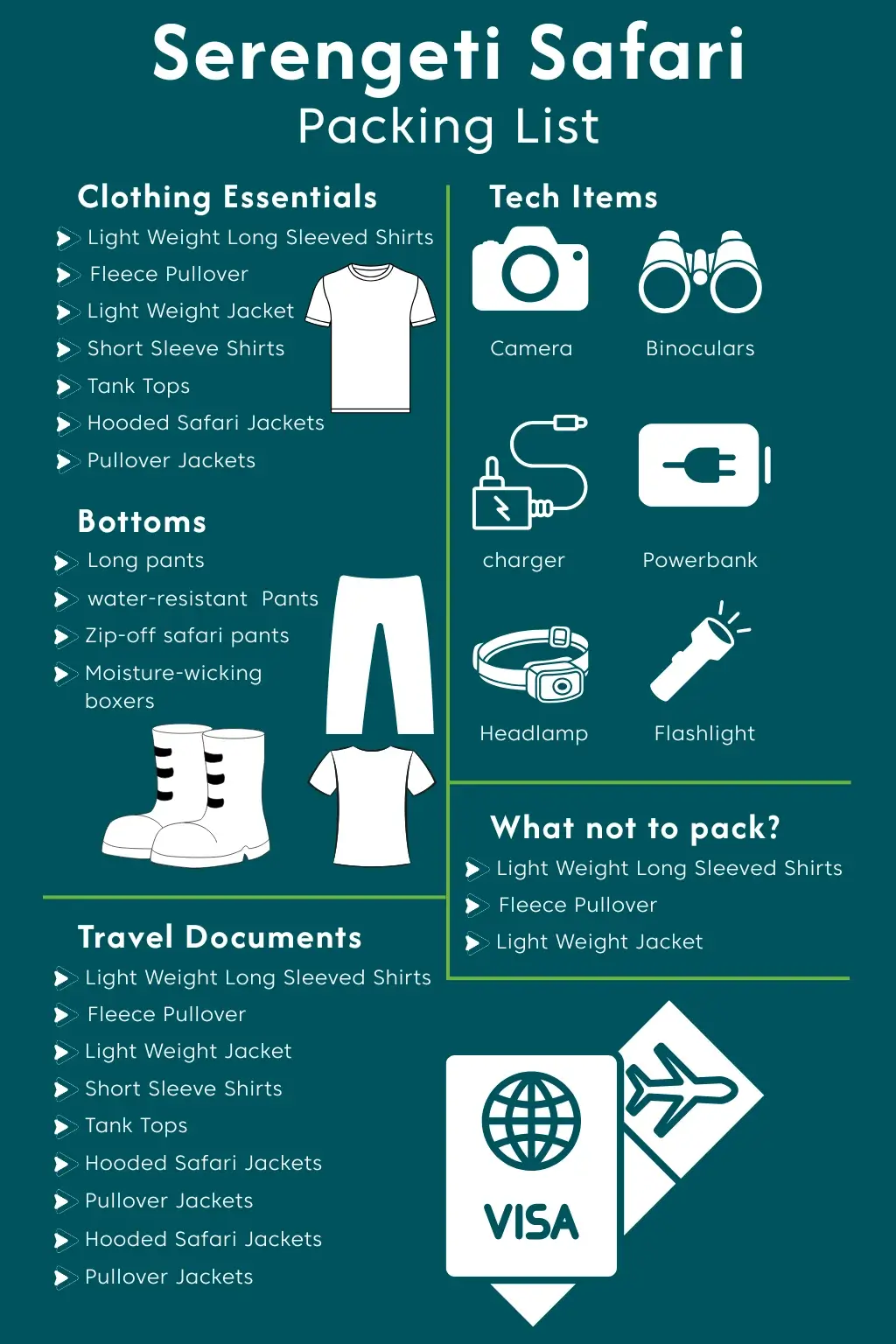
Serengeti Safari Packing List
Packing for Safaris in Tanzania can be overwhelming, as there are many items to consider. The important thing here is to focus on the essentials—but identifying what those essentials are can be challenging. To provide you with a clear and practical guide, we’ve compiled a comprehensive Serengeti Safari Packing List. Be sure to include the items below as part of your preparation checklist.
Serengeti National Park Packing List
What not to pack?
From the above list, you have gained some insights into packing essentials. But what not to pack for Serengeti safaris is just as important. So, below are some items you should not pack for safaris in Serengeti National Park.
- Camouflage and military-inspired clothing
- Drones. They are banned inside the premises of Serengeti National Park.
- Hairdryers. Most camps and lodges won’t be able to handle the power capacity of hairdryers or hair straighteners.
You should also keep in mind that plastic bags are banned in Tanzania. So, you should not bring them. Although zip-lock bags are permitted, if needed, you can pack them.
Need help packing?
Refer to our Tanzania Safari Packing List for a complete checklist of everything you’ll need for your adventure in Tanzania—so you don’t miss a thing!
The Great Migration Serengeti
In short, the Great Migration is the race of life for the herbivores of the Serengeti. It is the greatest show on our planet, and you’ll get the opportunity to witness this stunning spectacle on Safari in Serengeti.
The expedition of the main cast in the migration – the two million wildebeests begin in Southern Serengeti. This happens after the mass calving season, in January and March. This is the favourite season for all of the safari-goers and the atmosphere during this time is filled with new life and exciting action.
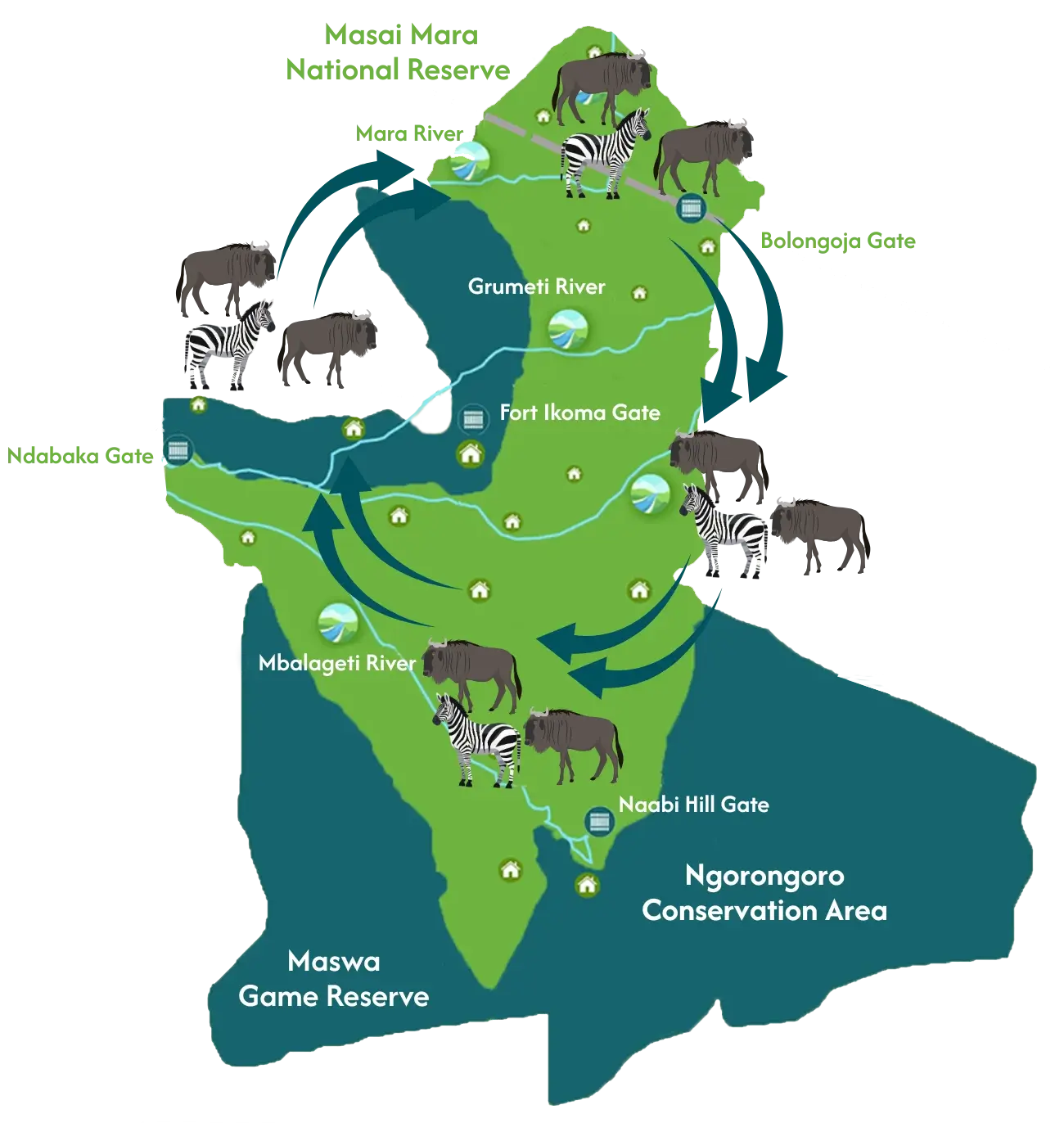
Serengeti National Park Migration
Why does the Great Migration happen?
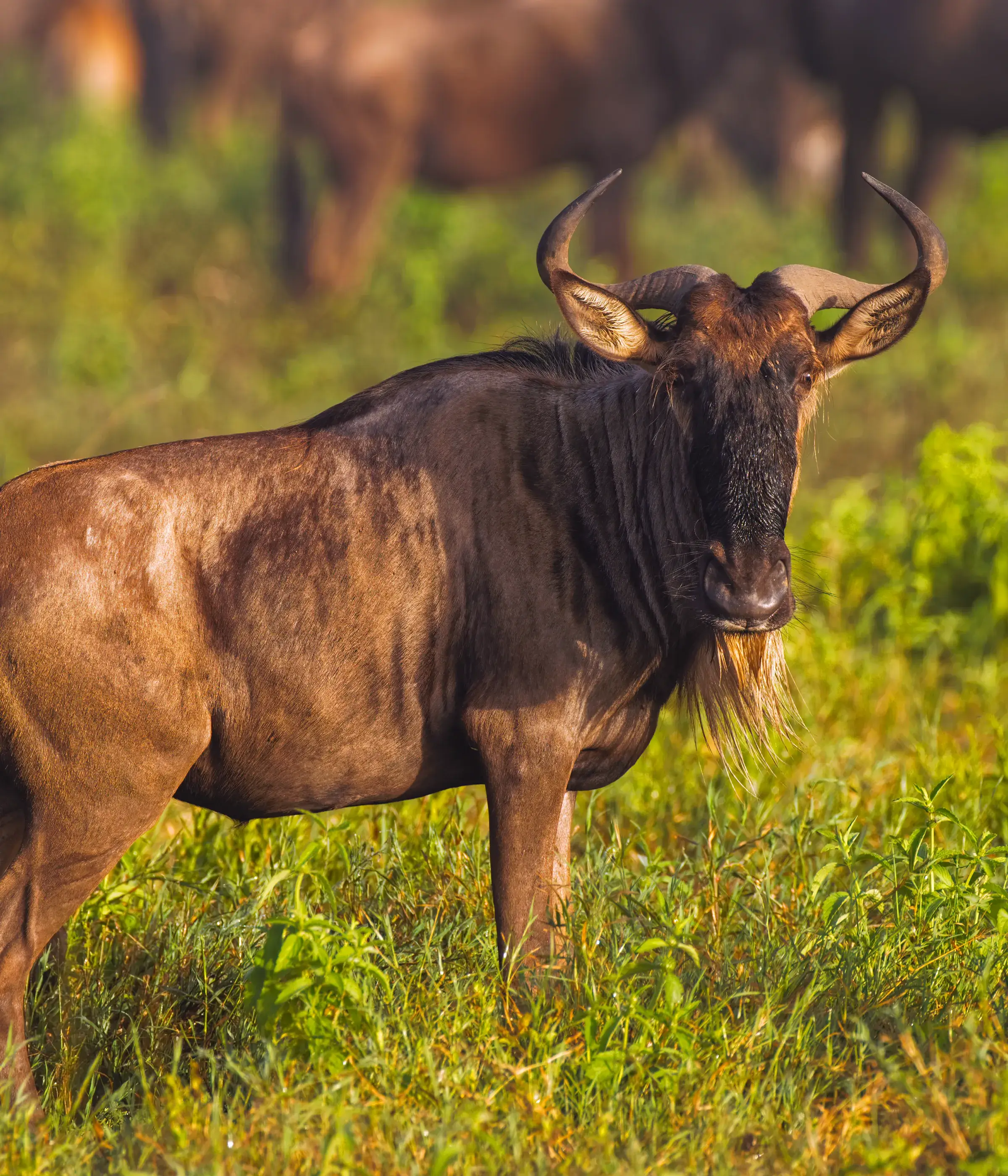
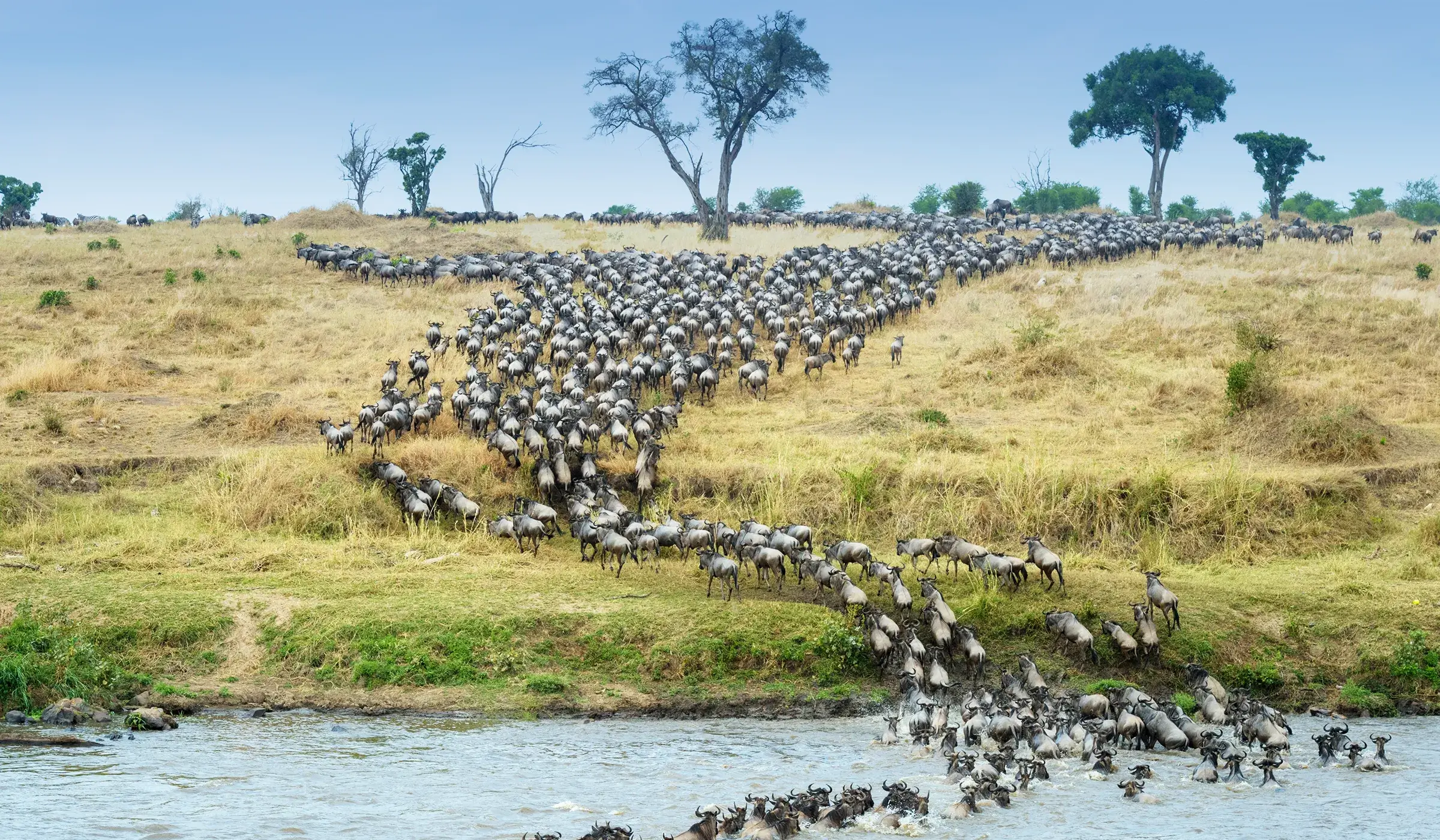
The 800-kilometre journey of the supersized herds of wildebeests, zebras, and gazelles is the largest mammal migration on Earth. The timing of the migration corresponds with the wet season when the short grass plains turn a lush green.
- The region is much safer because the shorter grass offers a great place for calving.
- This is because predators can be easily spotted, so if the animals sense any danger, they have plenty of time to run away.
- But, the plains soon dry up and the wildebeests have to move in search of greener meadows in the Western Corridor.
Serengeti’s northern ecosystem receives the highest amount of rainfall, and yet the grasses are the least nutritious. This is the dry season getaway for the herds, which is until the grass transforms greener again. The result is a clockwise movement from the south, west, north, and finally back again to the south.
The Annual Cycle of the Great Migration
Although some variations happen at different points, the migration in Serengeti National Park follows a fairly predictable annual cycle. This is dictated by the local rainfall patterns. The following periods are the cycles of the Serengeti Great Migration Safari.
From December to April
The main calving grounds are in the Seronera region. Wildebeests stick around this area until the long rains (around late April and early May). The great news is that this section of the Serengeti is easily accessible and the surroundings are wonderfully vibrant.
- February is the calving season in the Ndutu plains.
- Several wildebeests and zebras give birth to calves and this spectacle works as a magnet for the predators.
- Then, in late March and early April, the herds move again in search of greener grasses.
- Witnessing the actual migration in this period may be a bit challenging, but you’ll for sure see large herds on the move.
From May to July
These months see the wildebeests getting ready for their 800-kilometre-long trek. This is the time when you’ll get the chance to see one of the greatest phenomena on the planet. I.e. more than a million wildebeests marching in a column up to 40 km long.
- During this journey, the herds move towards the Western Corridor.
- This is where they face the major challenge—crossing the Grumeti River.
- Many animals perish here, as they are awaited by the deadliest crocodiles.
- This is the circle of life, where the weak ones have no place in the natural course of the world.
From August to September
After tackling the battle of the Grumeti River, the herds move further north and come against the greatest battle for survival. This is the Mara River Crossings. So many iconic pictures of this spectacle have been taken here.
- Whilst on Safari in Serengeti Tanzania, you’ll witness these herds tumble into the great Mara River, where some of the deadliest crocodiles await attack.
- After the Mara crossings, the herds move towards the northwestern plains and eventually to the Masai Mara National Reserve in Kenya.
- An interesting thing that happens is about half of the herd stays on the Tanzanian side, in the Mara Serengeti region.
In October and November
This period sees the herd cross the northern plains and Lobo Hills region of the Serengeti. This area is rarely visited, so if you want to experience the Great Migration in complete exclusivity, then this would be the time.
- The herds return to the short grass plains of the calving grounds around the Ndutu region in late November.
- And from here, the Great Migration begins all over again.
Top Safari Experiences in Serengeti National Park
Endless golden savannahs, majestic creatures, the greatest show on our planet, and some of the most gorgeous sunsets you’ll ever get the pleasure to witness! All of this and much more await you on Safaris In Serengeti National Park.
Top Safari Experiences in Serengeti National Park
Going on a Safari in Serengeti Tanzania is an intensely personal experience, and you should indulge in experiences that excite you the most. So, to help you decide which ones to add to your adventure, the following are the top Serengeti National Park Activities to enjoy during your trip:
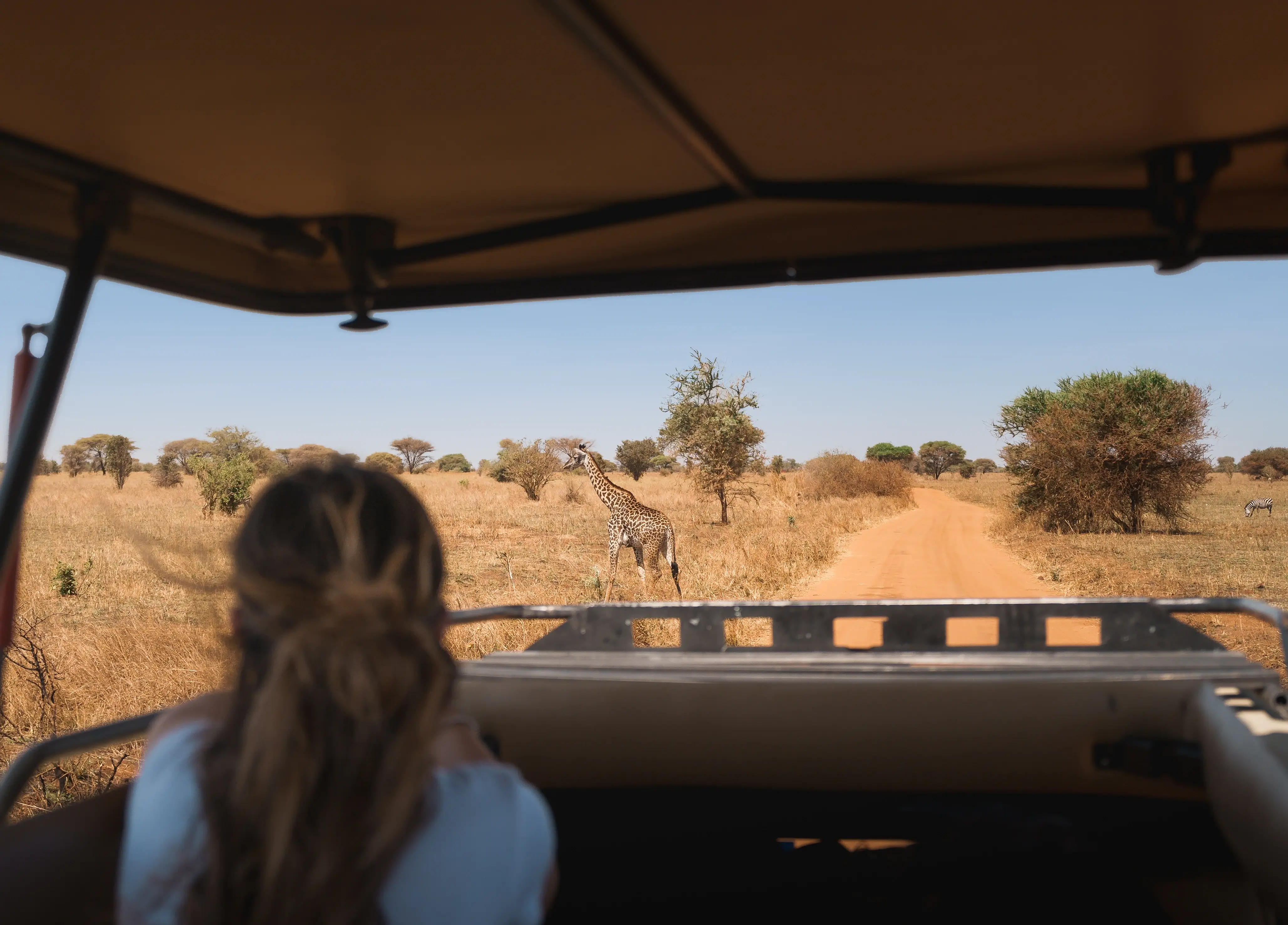
Game Drives
Picture driving across the rich savannahs of the Serengeti on a safari jeep, surrounded by mountains and craters. Right next to your safari vehicle, there’s a gathering of wildebeests. After driving for a while, you happen upon a pride of lions.
This scene looks straight out of a movie—but you’ll live this cinematic moment for real in the wildlife kingdom of Serengeti National Park.
To have the perfect game drive experience in Serengeti you need to know what itineraries are available with us. Thus, the following are some of our and travellers’ favourite and popular Tanzania Safari Itineraries:
7 Days Big Five Safaris In Tanzania – This itinerary will help you conquer the quest of spotting the big five. You’ll be transported to the wildlife kingdom of Serengeti and Tanzania’s Biodiversity capital – Ngorongoro Conservation Area. Along the way, you’ll also get brilliant sightings of herds of wildebeests, zebras, and other antelopes.
10 Days Tanzania Closer To Nature – Set out on an up close and personal excursion in the lap of nature! This itinerary is close to our hearts and even closer to the splendid Tanzanian Bush. You’ll get to explore all of the national parks of the Northern Circuit, including the endless plains of the Serengeti.
Not satisfied yet? Then, explore our range of other fabulous Safari itineraries that’ll take you to the beating heart of Tanzania. Simply follow Tanzania Safari Tours and discover a whole other world of possibilities.
After your game drive, you’ll make your way to the accommodations. And look back on your dusty road experience with a sense of awe. These dusty roads had a story to tell, one that you’ll remember whenever you see a particle of dust in your life.
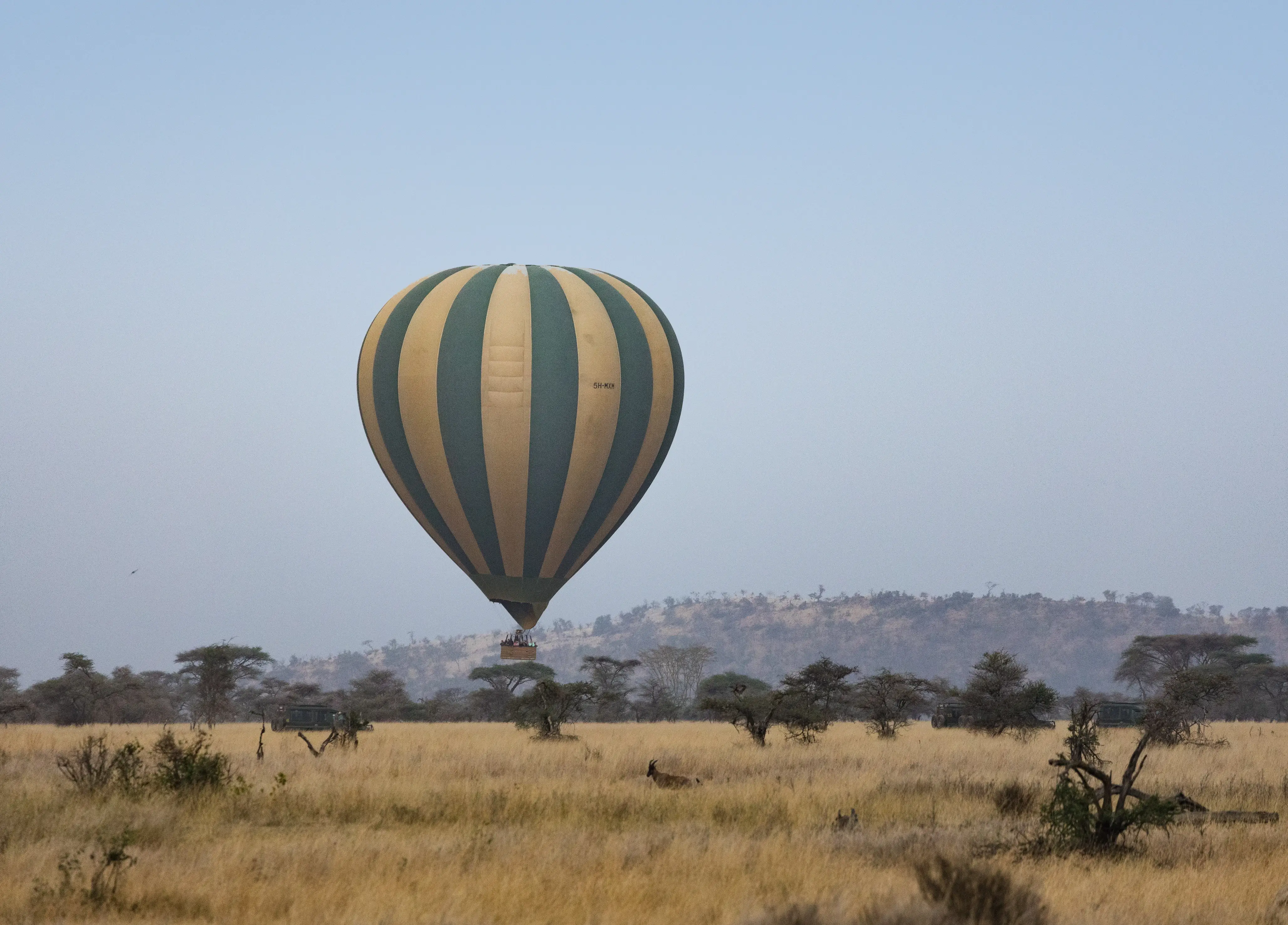
Hot air balloon safaris
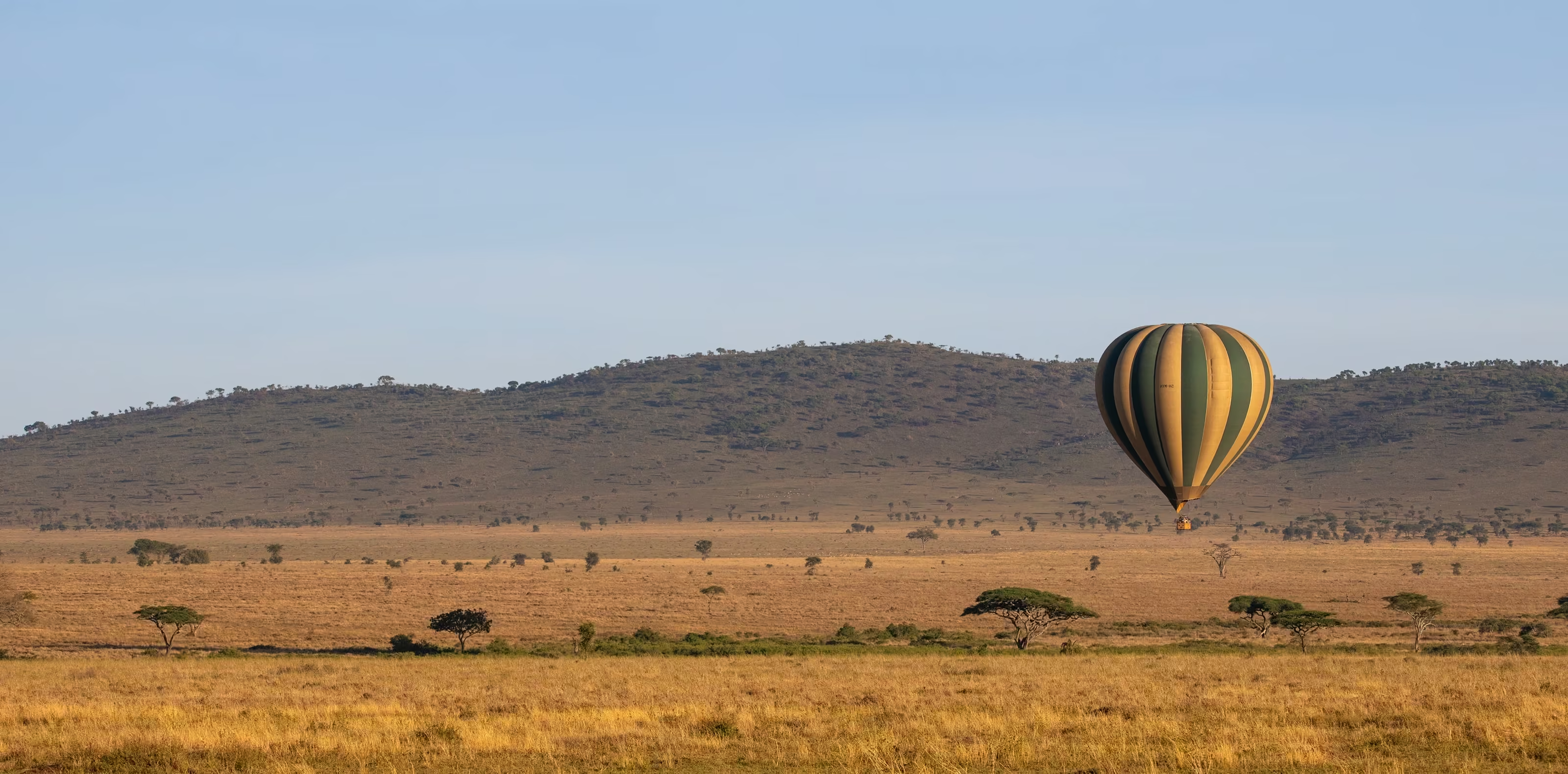
The Serengeti National Park is a vast landscape. So, to take in a large portion of the landscape, Hot Air Balloon Safaris are a great choice. They usually start early in the morning, and you’ll witness the sunrise peeking out from under the mountains as large herds of wildebeests walk beneath you.
The panoramic view from above is simply stunning. After your ride, enjoy a glass of champagne and a delicious breakfast. Isn’t that a perfect start to your day?
The Great Wildebeest Migration
Nothing will make you stand in awe and appreciate the complexity of life more than the greatest show on Earth. The circle of life unfolds before your eyes, revealing the raw beauty of nature.
Herds of wildebeests, zebras, and gazelles move across the plains, with predators like crocodiles and lions lying in wait. It’s dramatic, real, and unforgettable—and easily one of the most iconic Things to Do in Tanzania.
Visit the Moru Kopjes!
In the middle of the Serengeti lie the massive Moru Kopjes—enormous, round rock formations that rise from the ground. They provide shade, water, and cover for wildlife throughout the park. These kopjes also serve as lookout points for predators like lions.
Game drives through this area might feel as if you've stepped into a scene from The Lion King.
Over two million animals move through Serengeti’s golden plains—wildebeests, gazelles, zebras, lions, cheetahs, and hyenas—creating nature’s most breathtaking theatre during the Great Migration in Tanzania.
Going Beyond the Great Migration
Witnessing the greatest show on Earth will be an awe-inspiring sight, that’s for sure. But many visitors overlook the fact that Serengeti National Park has many other things to offer too. Below are some examples.
Maasai Tribes
The culture inside the Serengeti National Park is just as rich as the wildlife. It is a blend of impacts—impacts that the native tribal communities have had on the park for years. The culture isn’t just limited to humans, but also human ancestors (Australopithecus Afarensis) who lived around the area for almost 4 million years.
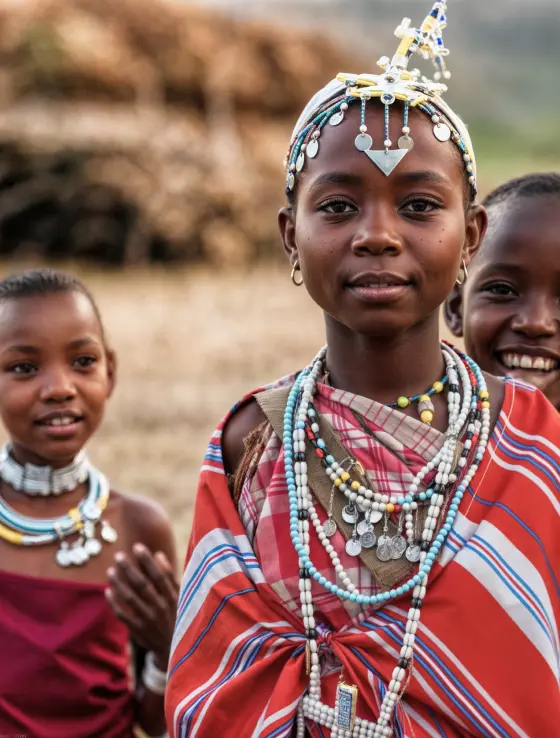
Today, the Serengeti is still home to many indigenous communities. One of the most famous is the Maasai people. The Maasais are popular and unique because of their long-preserved culture.
The pastoralist Maasai communities inhabit the eastern region of the Serengeti ecosystem, including the Narok district and the Lolindo area. They have stuck to their traditional way of life, making them a symbol of Serengeti and Tanzania’s culture. You too can experience their way of life on Serengeti safaris.
Cultural Tours
The culture inside the Serengeti National Park is just as rich as the wildlife. It is a blend of impacts—impacts that the native tribal communities have had on the park for years. The culture isn’t just limited to humans, but also human ancestors (Australopithecus Afarensis) who lived around the area for almost 4 million years.
Today, the Serengeti is still home to many indigenous communities. One of the most famous is the Maasai people. The Maasais are popular and unique because of their long-preserved culture.
The pastoralist Maasai communities inhabit the eastern region of the Serengeti ecosystem, including the Narok district and the Lolindo area. They have stuck to their traditional way of life, making them a symbol of Serengeti and Tanzania’s culture. You too can experience their way of life on Serengeti safaris.
The Bond Between People and the Land
Going back several years, the Maasai people lived in harmony with the wildlife and the surroundings of the Serengeti. And they have to this day followed in the same footsteps.
Although, along with the advancement of life, they have also adapted to the modern world. Today, they are learning how to trade their crafts, grow crops, enhance their skills, and cooperate with the tourism sector of Tanzania.
The Maasai communities have rightfully established their place as drivers, trackers, guides, and cooks. This helps bring in revenue for the government and provides training opportunities for the younger generation. Their involvement in responsible tourism plays a key role in maintaining the delicate balance between culture, nature, and travel.
Conservation Efforts
The survival of wildlife is a matter of utmost importance! And to make sure that future generations will enjoy these precious inheritances, conservation is a must.
Tourism helps to generate international awareness of conservation issues. The presence of tourists also helps in preventing illegal poaching activities and assists park management with game monitoring efforts.
All Tanzania National Parks are managed by TANAPA. In the Serengeti, TANAPA works closely with the Serengeti Conservation Project organization. Their primary goal is conservation. They are dedicated to preserving the rich natural heritage of Serengeti National Park and provide secure breeding grounds where the diverse flora and fauna of the park can flourish.
Furthermore, sustainable tourism is also on the rise in Tanzania. TANAPA is committed to low-impact, eco-friendly visitation that will protect the environment from irreversible damage. This includes:
- Closely monitoring human activities
- Regulating development
- Disposing of waste in a controlled and careful manner
- Managing the distribution of visitors and facilities
All of this combines to ensure that there’s a clear minimization of the human imprint on the environment.
Accommodations In Serengeti National Park
The land of the Serengeti can be a blend of wilderness and comfort. A crisp linen king-size bed? For sure! A viewing balcony to see the animals crossing by? You have it! Mouth-watering delicacies served under the starry night skyline? This is the place!
- A bag full of safari memories needs a cosy bed for the night. And the accommodations of the Serengeti deliver!
- With choices like eco-friendly campgrounds, tented camps and lodges, luxury safari lodges, and mobile camping.
We’d love to help you set up a base away from home that offers experiences that will be everlasting. So, the following are some recommendations about Serengeti Accommodations:
Embalaki Camp
This is a great choice for budget travellers and backpackers looking to experience the authentic natural wonder of the Serengeti. The camp is created to offer great amenities while you relax in the comfort of your tented lodging.
There are night bushfires set up outside the camp as well. This is where you can unwind while gazing at millions of stars in the clear skyline of the Serengeti.
Thus, just let go and appreciate the beauty of the Serengeti Bush while living off the natural clock!
Wayo Africa Camps
Just a notch above the budget choices, this camp may be light on the ground, because it’s eco-friendly, but it’s high on experience. This Serengeti Green-tented camp offers brilliant amenities. Such as non-stop safari adventures, stunning natural sceneries, sundowners and bush dinners.
Experience the mixture of immersive safaris and memorably luxurious rooms, right in the land where the human race began!
Four Seasons Safari Lodge
This is probably one of the most magnificent safari lodges in the savannahs of the Serengeti. If you’re looking for a top-of-the-line luxury safari lodge, then venture no further, this is it right here! The lodge sits right next to a large watering hole where several animals gather in all four seasons.
So, enjoy sundowners on your deck and spot a family of elephants drinking water and bathing. Or satisfy the adventurist in you and go on game drives and hot air balloon safaris. Whatever you’d like to do, a refreshing spa will be waiting where you can re-energize yourself for the next adventure.
Luxury Accommodations
- Lemala
- Asilia
- One Nature
- Elewana
- Nimali
- &Beyond
- Four Seasons
- Melia
- Wellworth
Midrange Accommodations
- Serena
- Karibu Camps
- TWC
- Acacia Camps
- Sopa Lodge
- Wayo Africa
Serengeti Through the Famous Lens
As expected, the marvellous Serengeti has made its way into the hearts of many international leaders and celebrities. So, the following are some big names that have visited Serengeti National Park and enjoyed the wonders of the endless plains.
Lupita Nyong’o
Oscar Award winner and Hollywood actress, Lupita Nyong’o visited Serengeti National Park over the Easter holidays in 2021. She was indeed thrilled by the experience and game drives and she didn’t hold back one bit. She posted an image on Instagram of her and an enormous elephant in the backdrop. The caption was - “This is not a zoom background, I promise! #elphie in the Serengeti,”
She was also a part of the Discovery documentary titled ‘Serengeti’, where she played a significant role as a narrator.
Will Smith
Along with the company of his wife Jada Pinkett Smith, Will Smith visited Serengeti in 2019. He was shooting a National Geographic documentary titled – ‘Welcome to Earth’.
Barrack Obama
In 2018, the 44th President of the United States, Barrack Obama visited Kilimanjaro. He visited along with his wife and two children. They spent eight days in Tanzania and part of this trip was in Serengeti National Park.
Justin Timberlake
The honeymoon safari of American singer-songwriter Justin Timberlake was in Serengeti National Park. He along with his wife, Jessica Biel went on a hot air balloon ride.
Stephen Curry
In 2021, the American basketball player Steph Curry visited Tanzania. He along with his wife visited the pristine beaches of the Zanzibar archipelago and Serengeti National Park.
Key Takeaways Of The Serengeti
The endless plains of the Serengeti are teeming with all kinds of natural splendours that you can imagine. Want panoramic landscapes? You’ve got it! Some of the most diverse wildlife ever? No worries! Luxurious accommodations and amenities? It’s covered!
A welcoming place for couples, groups, backpackers, and families alike – the Serengeti is perfect for everyone! So, with that in mind, the following are some of the major takeaways of Safaris in Serengeti National Park:
- A place where wildlife flourishes, with over 2 million hooved animals, 400 lions, 1000 leopards, 500 cheetahs, and more than 500 species of birds.
- Picture the perfect destination for safaris – with exhilarating game drives, and walking safaris!
- The largest wildlife spectacle on our planet awaits – The Great Wildebeest Migration!
- A private and remote safari – in the undiscovered plains of Grumeti Game Reserve.
- Unparalleled aerial views of the surroundings of the Serengeti – On Hot Air Balloon Safaris!
- Visit the site of our ancient ancestors, the cradle of humanity- the Olduvai Gorge!
- See the lazy giants bathing, feeding, and relaxing – at the Hippos Retina Pool!
- The flowing rivers, towering mountains and gorges of the Seronera River Valley.
- Experience the way of life of the semi-nomadic Maasai communities – On cultural tours.
- Get transported right into the Lion King – on a visit to the Moru Kopjes.
- Witness the calving season in the Ndutu Plains – and appreciate the discovery of new life!
- Exceptional birdwatching experience – see several endemic birds along with the secretary bird and Kori bustards.
- Spot the wildlife of the Serengeti when it’s most active – on morning safaris!
- The life force of the wildlife – the rich flora of Serengeti. See acacia trees, sausage trees, as well as umbrella trees, and yellow-fever trees on game drives.
Serengeti National Park PDF
Download a complete checklist with everything you’ll need for your Tanzania Safari—clothing, gear, essentials, and helpful tips, all in one handy guide.
What The Endless Plains Of The Serengeti Mean To Us!
Serengeti National Park is a paradise of exhilarating wildlife and loads of exciting safari activities. It’s the perfect picture of nature at its wildest and untamed. Yet, it offers a range of experiences that will take you right back to the roots of life.
- The park has both the coming of new life (in the calving season along the Ndutu plains) and the circle of life (in the dramatic Mara River crossings) in one package.
- This is why we want visitors to experience the sensational surroundings and enthralling wildlife safaris of the Serengeti. So, this Tanzania National Parks will fulfil even your wildest dreams, time and time again.
A remarkable thing that Serengeti teaches us is how we have to fight for our survival. We want everyone possible to experience this enriching wonderland of Tanzania too so that they will have a memory that will last for years and experiences that will last a lifetime.
Go on Safari with Us
Discover Tanzania’s untamed beauty with experts who bring every moment to life. From tracking lions to quiet sunset views, we make each day in the wild truly count.
Serengeti National Park FAQ'S
The word Serengeti comes from the Maasai language known as Maa. It’s derived from the word ‘serengit’ which means endless plains or the land that runs on forever. Though, you won’t find this etymology in Maa dictionaries. It perfectly fits the vastness of Serengeti National Park.
Serengeti National Park is situated in northern Tanzania. It lies entirely in the eastern Mara region and the northeastern area of the Simiyu region.
Almost all Tanzania Serengeti Tours start from the town of Arusha. The most convenient way is flying into Kilimanjaro International Airport (JRO), 45 km away from Arusha. You can also arrive via Julius Nyerere International Airport (DAR) in Dar es Salaam and connect to JRO or Arusha Airport (ARK).
The park’s main gates open at 6:00 am and close at 6:00 pm. Do not arrive later than 3:00 pm. During the wet season, timings may vary. Plan your Safari In Serengeti National Park accordingly.
Although Serengeti National Park was established in 1951, its origin lies in a small 3.3 sq. km. game reserve founded by British colonials to protect lions.
The park is world-renowned for the Serengeti Great Migration Safari. Over 1.5 million wildebeests, 300,000 zebras, and 200,000 gazelles journey through the ecosystem annually.
You won’t find tigers, bears, gorillas, or chimpanzees here. However, the park teems with African Serengeti Animals, including big cats, elephants, and rhinos.
You’ll find everything from budget camps to ultra-luxury lodges. Serengeti Safari Packages cater to every kind of traveller, combining comfort with adventure.
Yes! The park has dedicated campgrounds ideal for backpackers and nature lovers seeking Serengeti Trips with a rustic feel.
There are plenty of Things To Do In Serengeti National Park:
- Game drives
- Hot air balloon safaris
- Cultural excursions
- Birdwatching
- Visiting Olduvai Gorge
Due to high lodge demand, especially during peak seasons, it's advised to book your Tanzania Safari Packages 8–10 months ahead.
Self-drives are possible but not recommended unless experienced. Consider joining Serengeti Safari Tours for a seamless experience.
Yes, most areas have coverage, though some remote regions may not. Most Serengeti Safari Lodges offer Wi-Fi access.
5–6 days is ideal for experiencing different regions and Serengeti National Park Activities, maximizing wildlife viewing.
Yes, bring small bills for tips and souvenirs. It enhances your Safari In Serengeti Tanzania experience with local interactions.
The Greater Serengeti Ecosystem includes:
- Ngorongoro Conservation Area
- Maswa Game Reserve
- Loliondo Game Controlled Area
- Grumeti Game Reserve
- Ikorongo Game Controlled Area
- Masai Mara National Reserve, Kenya All are part of broader Serengeti National Park Packages.
Kopjes are granite rock formations rising from the plains. These iconic features, like Simba Kopje, inspired Pride Rock in The Lion King and are often part of Serengeti Tours.
Serengeti’s entrance fee for adults is $70.80 (per person, per day). The fee in the high season is $82.60 (per adult, per day). Children between the ages of 5 and 15, have to pay 23.60 (per person, per day).
Children below the age of 5 years can enter the park free of charge. All of the entry gates in Serengeti National Park accept credit cards.
Serengeti National Park is renowned across the globe for its massive concentration of wildlife.
The park is home to several species of big cats, countless herbivores, the Great Wildebeest Migration, all of the big five (buffalo, rhino, elephant, leopard, and lion), and over 500 species of birds. Rest assured, you’ll have a fantastic time in the Serengeti if you’re a wildlife enthusiast.
Simbo Natai, a Germany-based travel consultant, spent seven years living in Tanzania before returning to snowy Schleswig
About the author





 African Scenic Safaris #1 on TripAdvisor